Electrification opens the door to greater integration of printed electronics in vehicles
Electrification requires a rethinking of almost every component of a vehicle. The market is leaning towards technologies that reduce weight and energy consumption to extend battery range and, at the same time, offer passengers premium complementary features.
As usual, suppliers of printed electronics technology demonstrated their suitability to meet these challenges. Among other things, they printed integrated armrest heaters with LED lighting and in-mold electronics for component connectivity across the entire interior surface. BMW and Eink even showcased their concept cars with color-changing exteriors.
However, despite the ongoing demand for optimized energy efficiency and low weight, printed technology solutions have historically struggled to secure large order volumes in the automotive market. This is often attributed to higher associated costs or regulatory barriers compared to existing solutions. Despite some disappointment within the industry, a revolutionary application is emerging with the potential to tip the scales in favor of printed technology: battery management.
LOPEC highlighted the increased interest in thermal management and hot spot detection technologies. Among the most popular solutions is printed and flexible sensor technology capable of mapping temperature and pressure spatially in conjunction with active heating. Large-area printed sensor arrays that measure relevant physical metrics (e.g., swelling and heating) provide localized, granular information to improve cell deployment during loading and unloading.
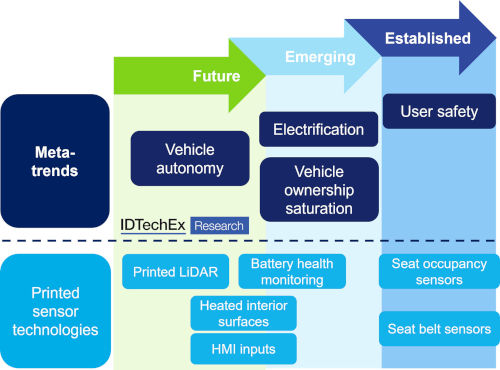
Metatrends in the automotive industry and emerging printed sensor technology. Source: IDTechEx
The use of large-area, printed, multifunctional sensors enables the integration of thermal management solutions with minimal impact on weight and size, while still meeting anticipated regulatory and safety requirements. Although the exact timeline for new regulations remains uncertain, technology providers are well-positioned to remain agile in meeting tailored customer needs, from research and development of new battery materials to active battery monitoring during operation.
Cultivating the downstream value chain will increase the chances of success for printed electronics
Cultivating collaboration in the later stages of the value chain was a frequent topic of conversation this year at LOPEC, the need for which was made clear by the strong representation of the value chain at the conference and exhibition.
Over the past few decades, a healthy ecosystem for printed electronics has been established thanks to close collaboration between material and technology suppliers. However, to realize the growth potential in key markets, closer collaboration with product designers, manufacturers, service providers, and end users is essential.
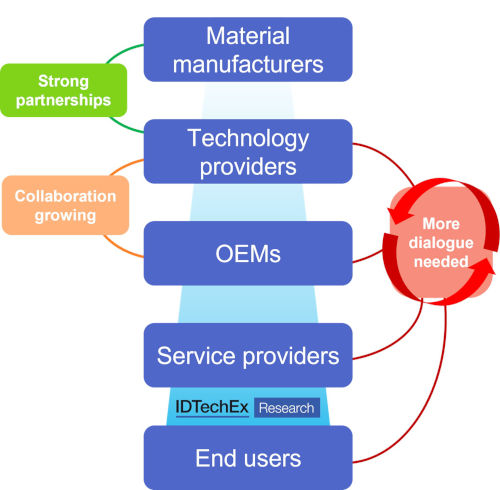
State of the printed electronics value chain and areas for improvement. Source: IDTechEx
The automotive sector is already highly vertically integrated, with well-defined supply chains and close feedback loops between original equipment manufacturers (OEMs), suppliers, and end users. This provides a clear entry point for printed electronics (PE) technology and is a key reason why the sector is such a significant target.
Healthcare is one of the largest potential markets for PPE, but unlike the automotive sector, adoption of PPE technology has been quite slow. This is largely attributed to the disparity and disconnection of the value chain. Furthermore, designing a successful business model that incorporates the diverse needs of medical device manufacturers, healthcare providers, insurers, and patients alike is a real hurdle.
Currently, a popular strategy for marketing printed electronics in healthcare is to offer simple, retrofittable, and low-cost sensing solutions. Examples include printed pressure sensors for hospital beds, which improve rehabilitation, and leak sensors for ostomy bags, which reduce the risk of infection. By integrating low-cost sensors into existing equipment, these solutions fit into existing value chains without reinventing the wheel.
Retrofit applications are just a small part of the potential applications of printed electronics in healthcare. For the full growth potential to be realized, a champion must emerge to focus technology providers on developing value-added solutions.
Healthcare institutions involved in clinical trials are increasingly likely to lead this initiative. IDTechEx believes that co-developing printed electronics in healthcare wearables offers an opportunity to gather more data and decentralize clinical trials. Healthcare institutions are poised to combine their already sophisticated patient information and established physician relationships with printed electronic technologies that enable continuous remote monitoring.
Small steps are being taken towards sustainability and the reduction of electronic waste
Striking a balance between product performance and sustainability is becoming increasingly difficult. Among the challenges is the complex mix of materials and the composition of device stacks. Printed electronic devices, composed of plastic substrates, glues and adhesives, mixtures of metallic and functional inks, pick-and-place integrated circuits, and sensors, are difficult to disassemble, separate, and recycle. A key link is missing at the recovery and separation point, preventing the emergence of effective circular processes.
Instead, the focus is on developing biodegradable and compostable materials. Examples include conductive inks functionalized with biodegradable k-carrageenan elements, as well as nanocellulose film substrates that can be composted in thirty days. The development of biodegradable and sustainable printed electronic materials is primarily geared towards their use in biosensors and wearable patches. Unlike industrial and automotive applications, which require robust sensors with a long lifespan, the biodegradation timeframe is more suitable for disposable smart medical consumables. Similarly, this technology will also be applicable to smart packaging and will benefit from the more established recycling streams for consumer waste.
Conclusion and market outlook
At LOPEC 2024, printed electronics technology companies focused on leveraging established partnerships to build trust and foster manufacturer interest. Electrification is generating significant interest in printed electronics technologies, with battery management emerging as the latest major market disruptor. Progress in the automotive market also highlighted the need for strategic rethinking in the healthcare sector, particularly regarding later-stage collaboration. Underlying all of this is the ongoing challenge of sustainability. However, these concerns may also be premature for a technology market still struggling to achieve large-scale production.
The stage is set for printed electronics to capitalize on the megatrends in automotive and healthcare, but cultivating greater collaboration in later phases will be critical to defining and achieving success.
Author: Dr Jack Howley, Technology Analyst at IDTechEx