
According to the new IDTechEx report, "Long Duration Energy Storage Market 2024-2044: Technologies, Players, Forecasts," 1.4 TWh of long-duration energy storage (LDES) will be installed worldwide by 2044. While mechanical energy storage systems will be a key driver of LDES deployment globally, the 2040s are expected to see greater diversification of LDES technologies.
What LDES technologies are being developed?
Several LDES technologies are currently being developed and commercialized in key regions. These technologies can be classified as electrochemical, mechanical, thermal, and hydrogen storage technologies. Funding from the private, public, and governmental sectors has resulted in an investment of approximately $4 billion in companies developing these technologies (excluding hydrogen).
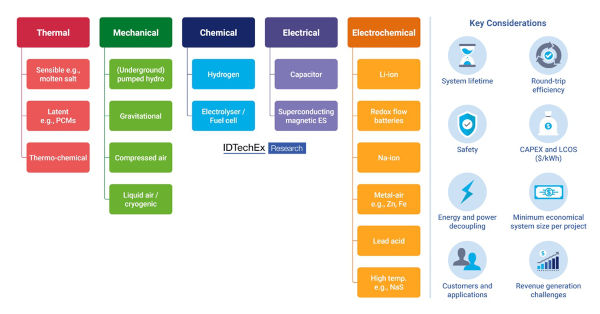
Classification of energy storage technologies. Source: IDTechEx
Many of these technologies are likely to be cheaper than lithium-ion batteries in terms of $/kWh, possibly due to the use of less expensive materials and other designs that allow for the decoupling of energy and power. Energy capacity-independent scaling would mean that systems such as redox flow batteries (RFBs), pumped underground hydro storage, liquid and compressed air storage, and some zinc battery designs would benefit from reduced capital costs (on a $/kWh basis) for longer-life storage. For example, in the case of liquid air energy storage (LAES), the liquid air storage tanks could be scaled up, while the turbomachinery would only need to be scaled up with power generation. As renewable energy penetration increases, longer average-life storage will be needed in key regions. Therefore, by the 2030s, the cost of LDES technologies at commercial scale is likely to decrease, demonstrating their advantage over lithium-ion batteries.
Which LDES technologies will prevail in the market?
Although, due to the current lack of commercial-scale deployments, it is difficult to accurately determine which technologies will be the most economical to deploy, factors such as round-trip efficiency (RTE), lifetime, and energy density will also be key factors influencing the success of these technologies.
In the long term, mechanical energy storage systems are likely to make a decisive contribution to LDES, given that their deployment above 100 MW is more cost-effective and their storage is more durable. For LAES, liquid carbon dioxide energy storage (LCES), and underground pumped hydro storage, it is possible to expand the capacity and, therefore, the storage life of these systems after initial commissioning, which is another advantage. Furthermore, some developers are already planning to deploy GWh-scale mechanical energy storage systems by 2030.
Other systems whose market share will increase in the 2040s include iron-air (Fe-air) batteries, rechargeable zinc batteries (e.g., Zn-air, static Zn-Br), RFBs, and thermal and electrothermal energy storage. Leading alternative battery manufacturers include Form Energy, which is developing iron-air systems for 100 hours of storage, and Zn-air battery manufacturers such as Zinc8 Energy and e-Zinc. Most of these companies are in the pilot or early stages of commercial development. These technologies will benefit from the use of low-cost materials, although their lower energy conversion rates (40–60%) may also lead to their use in lower-performance applications, such as standby power. Furthermore, these technologies will depend on achieving very low capital costs and/or require significant levels of renewable energy penetration to be suitable for LDES applications.
Thermal energy storage (TES) is already used in applications such as concentrated solar thermal (CSP) district heating, the cold chain, and building heating. However, industrial companies are likely to increasingly use TES systems to decarbonize their heat production processes, which have traditionally relied on natural gas combustion. This will help minimize any penalties for releasing greenhouse gas (GHG) emissions above a certain threshold. Key players developing TES technologies include Electrified Thermal Solutions, Kyoto Group, Rondo Energy, and Brenmiller Energy, to name a few. TES has a higher efficiency ratio (ERT) for heat-to-heat conversion than for heat-to-electric conversion (approximately 95% versus 40–60%) due to heat-to-electric conversion losses with a turbine and generator in discharge. Therefore, most of these systems will aim to supply heat rather than electricity. Consequently, these systems are less likely to be deployed on the same scale as other technologies for low-energy decarbonization (LDES) applications.
However, TES could also be used in CAES and LAES designs instead of using natural gas to provide expansion heat to the air during discharge. In an interview with IDTechEx, an LAES system developer commented that the waste heat from TES could also be used to supply heating to district heating networks, instead of being vented, and where the temperature requirements are much lower (100-140°C) than for providing expansion heat to the air. This could increase the RTE of the LAES system from 55% to 70%. Ultimately, while TES will be key in decarbonizing industrial heating processes, some systems could continue to be used for LDES applications or act as enabling technologies to improve the RTE of CAES and LAES systems.
Barriers and Prospects for LDES Deployment
One of the main obstacles to the large-scale deployment of LDES technologies is the need for long-term revenue visibility. Since LDES systems will mostly be 100 MWh to GWh systems, their value could range from $100 million to $1 billion. Current wholesale electricity price arbitrage opportunities are not typically long-term or large enough to economically justify widespread LDES deployment at present. LDES developers will try to secure capacity market contracts to ensure high annual revenues in the long term, but this is unlikely to cover most of the investment in an LDES technology alone. Finally, in an interview with IDTechEx, some key players commented that regulatory reforms are needed for revenue generation from energy storage to improve the economic case for LDES technologies and increase investor confidence. Ultimately, however, and depending on the penetration of VRE, it will not be until the mid-2030s that demand for LDES technologies will begin to accelerate in key regions, and broader global demand will not arrive until ~2040.
Author: Conrad Nichols, technology analyst at IDTechEx