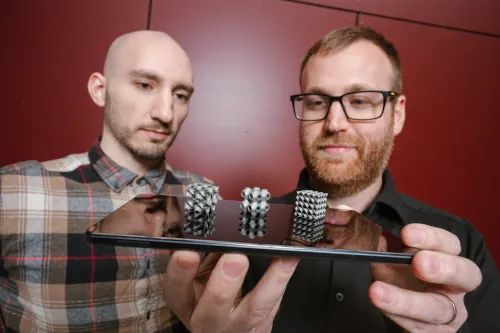
In collaboration with 3D printing specialists led by Professor Dirk Bähre, they are also developing novel and energy-efficient geometries for cooling elements. The gleaming cubes, each with a striking geometry, could easily be mistaken for elegant decorative objects. However, for the researchers working with these 3D-printed structures, their appeal lies in their functionality rather than their aesthetics. The manufacturing engineers in Professor Dirk Bähre's team and the smart materials specialists led by Professor Paul Motzki are interested in how these metallic structures perform in the innovative cooling and heating systems currently being developed in Saarbrücken. "This is the next stage in the development of elastocaloric technology. The research we are currently conducting on these new structures is still in the realm of basic research, but we are already thinking about their practical use and developing solutions for real-world applications," explains Paul Motzki. The novel geometries of these new cooling and heating elements are designed to increase heat transfer efficiency by maximizing the surface area over which thermal energy is exchanged.
Instead of cooling with climate-damaging refrigerants or heating with fossil fuels like oil or gas, elastocaloric systems use components made from the shape-memory nickel-titanium alloy. So far, Paul Motzki's team at Saarland University has been investigating the elastocaloric properties of ultrafine wire bundles and thin sheets made from this alloy. These components release heat when stretched or compressed and absorb heat when the mechanical load is removed. The engineers in Saarbrücken are using the elastocaloric effect to transport heat from one place to another, for example, to extract heat from a refrigeration chamber. Research teams from Saarland University and the Saarbrücken Center for Mechatronics and Automation Technology (ZeMA) have been investigating the elastocaloric effect for over 15 years, with the long-term goal of cooling and heating cars, buildings, and industrial facilities in an environmentally friendly and energy-efficient manner. At this year's Hannover Fair, the team is demonstrating that its technology has moved beyond fundamental research and is well on its way to real-world applications.
Exciting New Materials:
Vast amounts of energy are consumed worldwide for cooling and heating, and as the climate changes, demand will continue to rise. Unlike conventional cooling and heating methods, elastocaloric technology promises significantly greater efficiency. Running exclusively on electricity, elastocaloric systems are as clean as the electricity used to power them. The European Commission has identified elastocaloric cooling as the most promising alternative to conventional cooling technologies, and the World Economic Forum included it among the “Top Ten Emerging Technologies.” The technology is based on the special properties of nickel-titanium, an alloy that, when deformed, behaves very differently from conventional metals.
Nickel-titanium is what is known as a “shape memory alloy,” meaning the material can be deformed and then return to its original shape due to a reversible phase transformation between two solid crystalline structures. This phase transformation is accompanied by heat transfer. “At room temperature, the alloy is in its high-temperature phase. When we apply tensile or compressive stress to the material, we force it into its low-temperature phase. This is an exothermic process in which the material heats up and releases heat to the environment. Once the material has cooled back to room temperature, we release the mechanical stress. This allows the alloy to return to its high-temperature phase, and since this is an endothermic process, the material cools down,” explains Paul Motzki. Simply put: when a nickel-titanium wire is stretched, it releases heat to the air or liquid flowing around it; when the stress is removed, it cools and is able to absorb heat from the environment. This cycle of repeated tensile loading and unloading of mechanical deformation is the key principle behind the new technology. No additional sensors are required, as the material itself possesses intrinsic sensing properties. “Each deformation of the wires corresponds to a specific electrical resistance value. Thus, resistance measurements tell us exactly how the material is deforming at any given moment.” “That means, in practice, a position sensor is integrated,” explains Motzki.
The researchers in Saarbrücken aim to maximize heat transfer by maximizing the surface area. The larger the surface area, the more efficiently heat can be transferred to the working medium—air or water. So far, the team has increased the surface area by creating bundles containing many ultrathin, shape-memory wires. In the next generation of these devices, the cooling and heating elements will provide even more contact surface area by incorporating a porous nickel-titanium geometric structure. To achieve this, Paul Motzki’s research group is collaborating with Dirk Bähre’s team to develop an intricate nickel-titanium structure through which the heat transfer medium (air or water) can flow. The researchers are refining and optimizing the design of these delicate alloy lattices. Various complex geometries are being experimentally tested to determine which structures produce the most efficient heat transfer. The three-dimensional alloy structures are produced layer by layer using additive manufacturing in a 3D printer.
Preparing the Technology for Real-World Applications
While experiments and laboratory tests continue, Motzki and his team are also working to develop the emerging field of elastocalorics for real-world implementation. The materials used in future elastocaloric refrigeration systems must be suitable for continuous operation in refrigerators and refrigeration units. “We are working to develop materials and designs that are robust enough for continuous use and easy to maintain. We incorporate questions about potential future applications into the development process from the very beginning; it is a fundamental principle of our research and also shapes the curricula of our degree programs, such as Systems and Materials Engineering and Sustainable Engineering,” says Paul Motzki, who, like Dirk Bähre, involves numerous doctoral researchers and undergraduate students in this work.
One of the questions being addressed experimentally is how to subject the materials to mechanical stress in a way that ensures a long service life. This involves adapting the alloy's properties to the tensile and compressive cycle regimes. "For example, in designs using wire bundles, we aim to achieve a service life of over one million cycles," says Paul Motzki. However, at some point, even the best material fatigues. "That's why we're also developing a simple and quick replacement concept. We're designing the relevant components so they can be easily swapped, as ease of maintenance is a key factor in determining whether this new technology can translate into reliable day-to-day deployment," explains Motzki.
Current Funding and Projects in Elastocalorics:
The German Federal Ministry of Research, Technology and Space is funding the “DEPART!Saar” project with up to €18 million under its “T!Raum” program. The aim of this project is to strengthen the Saarland economy by developing regional innovation and transfer structures that accelerate the transfer of elastocaloric technology to real-world applications. In the SmartCool project, funded by the Federal Ministry for Economic Affairs and Energy, engineers in Saarbrücken are collaborating with Volkswagen AG, Fraunhofer IPM, and Ingpuls to develop lightweight and energy-efficient cooling systems for electric vehicles. In another research project, the team is collaborating with European partners to develop an elastocaloric air conditioning system that can be used to cool and heat individual rooms in residential buildings. The project consortium, led by Paul Motzki, will receive a total of €4 million in funding under the European Innovation Council’s “EIC Pathfinder Challenge.” With additional funding from an ERC Starting Grant from the European Research Council, Paul Motzki and his team are advancing elastocaloric technology using a world-first combination of shape-memory materials and smart-film actuators. Dielectric elastomers are the second field of smart materials in which Paul Motzki is a recognized expert.