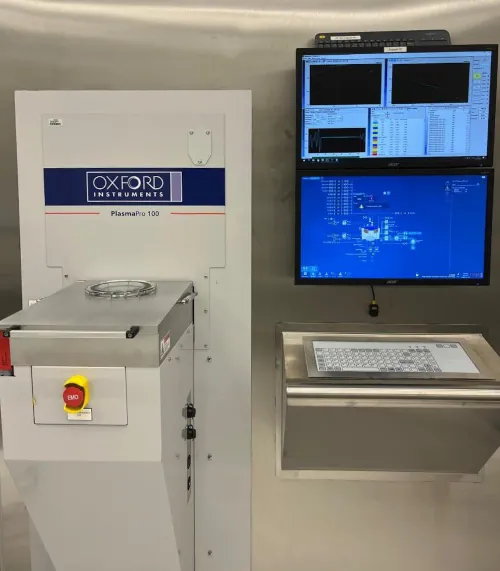
The work builds on more than a decade of fundamental research on quantum devices at Lancaster University, and advanced atomic-scale processing is now being carried out at the KAUST Core Labs using Oxford Instruments' ALE technology. This combination provides subnanometer control with ultra-low damage processing, a critical requirement for the precisely engineered quantum well heterostructures that underpin ULTRARAM.
ULTRARAM is a memory technology designed to combine the speed of DRAM-class memory with non-volatile data retention, offering the potential for improvements in energy efficiency and system performance. Achieving this requires precise control of interfaces and layer thickness within complex III-V semiconductor structures, making atomic-scale manufacturing techniques ideal.
“Atomic-scale control of our quantum well structures is fundamental to ULTRARAM,” said James Ashforth-Pook, CEO and co-founder of Quinas Technology. “Working with KAUST Core Labs and leveraging Oxford Instruments’ atomic-layer etching technology gives us access to one of the world’s most advanced and reliable environments for low-damage semiconductor R&D.”.
KAUST Core Labs enjoys international recognition in advanced nanofabrication, plasma processing and compound semiconductor research, and supports both academic excellence and industrial technology development.
"KAUST Core Labs supports cutting-edge semiconductor research through advanced nanofabrication facilities and atomic-scale processing tools designed for the development of low-damage devices," said Dr. Kenneth Kennedy, director of the KAUST Nanofabrication Core Lab.
“Atomic layer etching enables the precise, low-damage fabrication of nanoscale device components and is increasingly used in advanced semiconductor research and production environments worldwide. We are delighted that Quinas is using Oxford Instruments ALE systems at KAUST Central Laboratories to fabricate its ULTRARAM devices. KAUST is a long-standing Plasma Technology customer and has a suite of ALE and atomic layer deposition (ALD) systems, including the latest ALD technology, the PlasmaPro ASP,” said Harriet van der Vliet, Director of Strategic Markets R&D at Oxford Instruments Plasma Technology.
This milestone reflects Quinas Technology 's growing commitment to Saudi Arabia's advanced research ecosystem as part of its global R&D strategy and strengthens the company's position as it moves forward with ULTRARAM towards prototype demonstration and future collaboration with industrial partners, foundries, and strategic investors.