Among these innovations, encapsulation stands out as a critical area requiring significant development. It is the central theme of the new IDTechEx report, "Antenna in Package (AiP) for 5G and 6G 2024-2034: Technologies, Trends, Markets.".
Antenna-in-package (AiP) represents an advanced antenna packaging technology used in high-frequency telecommunications. Taking advantage of the short wavelengths of mmWave applications, AiP enables the creation of much smaller antennas that can be seamlessly integrated directly into semiconductor packages, unlike traditional discrete antennas mounted as individual components on printed circuit boards. This integration of the antenna and transceiver onto a single chip offers several advantages, including increased antenna performance and a significantly smaller package footprint. In the sub-THz frequency range, potentially within the 6G spectrum, new antenna packaging technologies are being investigated for direct integration into RF components. However, this field is still in the research phase due to various manufacturing and scalability challenges.
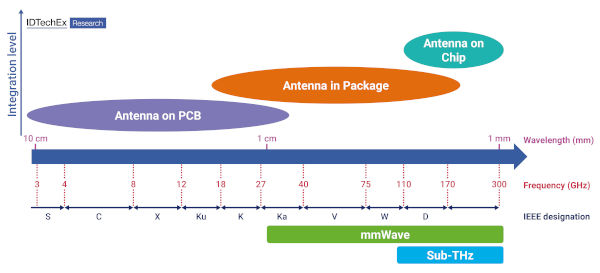
Overview of antenna packaging technologies based on operating frequency. Source: IDTechEx - "Antenna in Package (AiP) for 5G and 6G 2024-2034: Technologies, Trends, Markets"
Key considerations for AiP design
In the development of AiP technology for high-frequency communication devices, cost-effectiveness emerges as the most crucial consideration. With a target price of $2 per 1x1 AiP module, affordability is fundamental for widespread adoption, although this presents a chicken-and-egg dilemma, as adoption must precede cost reductions through economies of scale. The use of cost-effective packaging materials and processes is essential. Furthermore, miniaturization plays a critical role, particularly for integration into consumer devices such as smartphones, where component size is paramount. To ensure that package size can be reduced while maintaining performance and cost-effectiveness, it is necessary to leverage new packaging technologies.
Furthermore, achieving high performance is vital for AiP platforms. This involves the fabrication and integration of high-gain, broadband millimeter-wave antenna arrays, as well as ensuring electromagnetic compatibility (EMC) within the system. Optimizing the equivalent isotropically radiated power (EIRP) and ensuring signal integrity (SI) and power integrity (PI) are also crucial. Integrating high-quality passive components (Q-factor) to co-design active components of millimeter-wave front-end transceivers further enhances performance. Reliability is also essential, requiring direct thermal pass-through from the chip to the outside to dissipate heat from the power amplifiers. Scalability adds another layer of versatility, enabling the design of basic modules that can be expanded to meet diverse applications with varying power requirements. Considering all these requirements is essential when designing an AiP module for high-frequency communication devices.
This new report from IDTechEx delves into AiP technologies tailored for emerging 5G mmWave and 6G networks. It analyzes substrate technologies, including organic, LTCC, and glass, along with packaging methods such as flip-chip and fan-out, from material properties to manufacturing feasibility. The report explores antenna integration beyond 100 GHz, offers case studies, and addresses prevailing challenges, projecting a future driven by advanced semiconductor packaging solutions.
Author: Dr. Yu-Han Chang, Senior Technology Analyst at IDTechEx