However, the market as a whole tends to place less priority on innovation in materials and components. This article will shed light on some critical material and component priorities for major electrolyzer technologies, based on data from the IDTechEx report "Materials for Green Hydrogen Production 2024-2034: Technologies, Players, Forecasts".
Alkaline Water Electrolyzer (AWE): New electrode designs for improved efficiency
The alkaline water electrolyzer (AWE) is a mature and widely commercialized technology that offers the lowest system capital cost and predictable long-term performance. The AWE cell stack uses a liquid alkaline electrolyte (potassium hydroxide, KOH) along with a porous diaphragm and is based on widely available materials such as nickel and stainless steel.
One of the main challenges of AWE is its lower efficiency compared to its main competitor: the proton exchange membrane electrolyzer (PEMEL). Therefore, electrolyzer technology and materials developers have focused on producing high-performance catalytic coatings for electrodes to improve the efficiency of converting water into hydrogen and oxygen. High-performance coatings are commercially available, but many still rely on the use of critical platinum group metals (PGMs), such as ruthenium, in mixed oxide coatings.
Research on electrode coatings has focused on discovering and applying new catalytic materials. Among the most promising strategies is the coupling of traditional nickel with other transition and non-transition metals, for example, in NiFeCoP. Furthermore, the use of porous electrodes, such as nickel meshes, can be particularly well coupled with these types of coatings, producing highly nanostructured catalysts that offer large surface areas for reactions.
Pressing these electrodes against the porous diaphragm can further improve efficiency due to the shorter distance the chemical species must travel between reaction sites. This is known as a zero-void cell configuration and is already widely used in commercial AWE stacks. De Nora is one of the manufacturers of the zero-void cell components and advanced electrode coatings, and collaborates with established AWE suppliers such as McPhy Energy and thyssenkrupp nucera. IDTechEx expects that combining these material and component design strategies can further improve AWE efficiency, but more commercial efforts are needed across the board.
Proton exchange membrane electrolyzer (PEMEL): reducing the need for expensive and critical materials
Proton exchange membrane electrolysers (PEMELs) are gaining popularity due to their high efficiency, compact design, and adaptability to fluctuating renewable energy sources. While there is a movement toward standardizing materials in PEMEL fuel cells, innovation is far from stagnant, particularly in the development of anode catalysts.
Platinum (Pt) and iridium (Ir) catalyze the electrochemical hydrogen and oxygen evolution reactions that take place in the electrolyzer, respectively. The most modern materials used are platinum supported on carbon black (Pt/C) for the cathode and iridium black (Ir) or iridium oxide (IrOx) for the anode. The use of iridium in the anode is particularly problematic, as current loadings of 1 to 2.5 g/kW and the high demand from PEMEL systems can put significant pressure on the global iridium supply.
Catalyst suppliers, such as Heraeus Precious Metals, are addressing the iridium problem by coupling it with ruthenium in a mixed oxide catalyst (IrRuOx). Given the urgent need to reduce iridium loading, this material may be commercially available in the near future. Another strategy being explored in both academia and corporate R&D groups is the use of supported iridium catalysts, similar to the Pt/C approach. Furthermore, much research is focused on eliminating iridium in favor of other PGMs, such as ruthenium, by coupling it with transition metals in mixed oxides. Overall, iridium-free and PGM-free catalysts are still in an early stage of development. IDTechEx predicts that further research efforts will be needed to demonstrate their competitiveness and pave the way for widespread commercial adoption.
Other components of the PEM electrolyzer, such as the gas diffusion layers (GDLs) and bipolar plates, also use precious metal coatings, as well as titanium. Both of these may become more problematic in the future, so many companies are exploring new manufacturing and coating methods to reduce their reliance on these materials. For more information, see IDTechEx's previous research article on PEM electrolyzer materials.
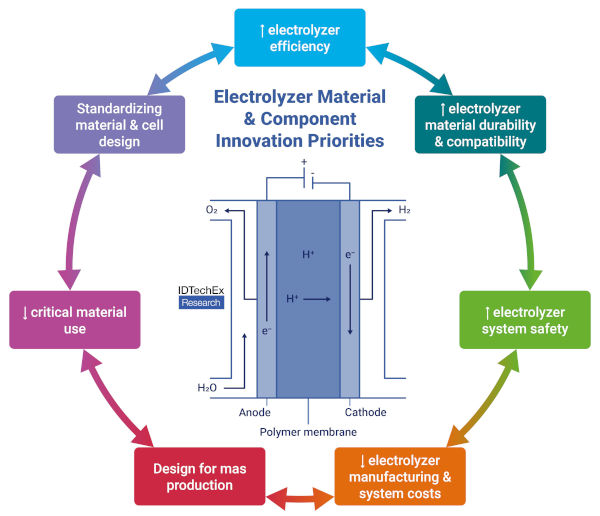
Innovation priorities in materials and components for electrolyzers. Source: IDTechEx
Anion Exchange Membrane Electrolyzer (AEMEL): Improving Membranes and Avoiding Critical Materials
The anion exchange membrane electrolyzer (AEMEL) is a relatively young but rapidly expanding technology that aims to combine the best of alkaline and PEM technologies. AEMEL seeks to combine the abundant materials of AWE with the high efficiency characteristic of PEMEL. This technology is experiencing rapid growth and innovation, exemplified by companies like Enapter, which are pioneering commercial megawatt-scale systems.
IDTechEx has observed that many research groups studying AEMEL technology continue to use platinum-iridium based catalysts in their electrodes. A key objective for industry and new commercial players should be to completely eliminate the use of PGMs and opt for high-performance nanostructured catalysts used in the AWE space. Furthermore, this technology could benefit from the application of gas diffusion electrodes (GDEs), which combine the gas diffusion layer with the electrode into a single component.
Another challenge is the wide variety of materials used in anion exchange membranes (AEMs), and consequently, their performance and durability. AEMs can benefit from some of the strategies observed in proton exchange membranes (PEMs), such as crosslinking the polymer chains and using support layers (e.g., PTFE) onto which the AEM can be coated. Material variation is likely to persist, but AEMEL developers can draw inspiration from current advances in AWE and PEMEL technologies, applying them to their own cell and stack designs.
Solid oxide electrolyzer (SOEC): cell structure optimized for high performance and low degradation
The solid oxide electrolyzer (SOEC) is also a relatively new technology in the electrolysis landscape, with a smaller market presence compared to AWE and PEMEL. SOEC operates at much higher temperatures (>600°C) than the aforementioned low-temperature technologies (50–90°C) and therefore requires very different materials and design approaches.
SOEC technology has greatly benefited from advances in materials from solid oxide fuel cell (SOFC) technology, as most SOECs are designed to operate reversibly, either as an electrolyzer (SOEC) or as a fuel cell (SOFC). While some ceramic components are already established in the technology, the development of new materials and electrode-electrolyte assemblies in SOECs is a promising area for innovation.
Innovation priorities include the use of electrolytes that allow for lower operating temperatures, which can provide long-term stability and cost advantages. Among these is gadolinium-doped ceria (GDC), already used in some commercial batteries, as exemplified by companies like Ceres Power. Another key aspect is the use of metal-supported cells (MSCs), due to several inherent advantages over electrode- or electrolyte-supported cells, which are more common in commercial batteries. These advantages include reduced material costs and a greater ability to withstand thermal cycling and mechanical stress. Furthermore, significant efforts are underway to improve the thermal and chemical compatibility of cell materials with interconnects, contact layers, and sealants.
More advanced materials may be adopted for SOEC batteries in the future. Overall, a wide range of materials are used in SOEC batteries, highlighting not only the diversity of the technology but also the potential for innovation in materials for these high-temperature electrolyzers.
Market outlook and strategic perspectives
Developers of electrolyzer technologies and materials face numerous challenges, many of which are interrelated. For example, reducing the thickness of the proton or anion exchange membrane can increase efficiency but may reduce membrane durability. Conversely, increasing durability through advanced materials and manufacturing techniques increases manufacturing costs. Consequently, there is no single optimal approach to materials and component innovation. However, this optimization process opens up significant business opportunities for the development of more sophisticated electrolyzer materials.
Author: Chingis Idrissov, technology analyst at IDTechEx