




Nickel manganese cobalt (NMC) cathodes have been preferred in the automotive industry for the last decade due to their higher energy density (Wh/kg), which allows for storing more charge and thus increasing range, one of the main concerns of potential customers.
However, another cathode chemistry (discovered in the 1990s) has experienced a surge in recent years, particularly in China. Lithium iron phosphate (LFP) offers a cheaper cathode than NMC and generally boasts favorable safety and lifespan characteristics. The trade-off is a decrease in energy density, typically around 170 Wh/kg (at the cell level) compared to 260 Wh/kg for NMC 811. Despite this, IDTechEx's in-depth study of the global electric vehicle market, "Plug-in Hybrid and Battery Electric Cars 2025-2045: Technologies, Players, Regulations, Market Forecasts," shows that plug-in hybrid electric vehicles (PMAs) reached almost 40% of the global automotive market in 2024. What does the resurgence of LFP mean for the electric vehicle market in 2025 and beyond?
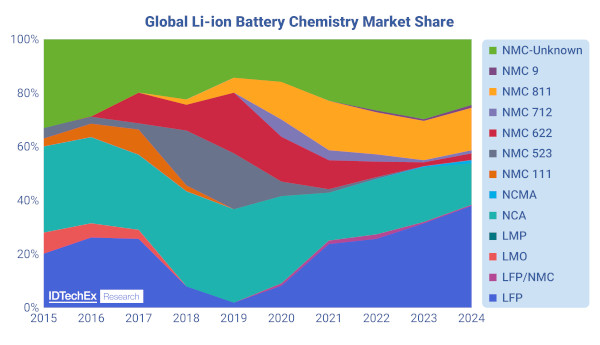
IDTechEx has been tracking the global electric vehicle market since 2015 and shows how market share has evolved by chemical composition. LFP saw a resurgence after 2019, primarily in China. NMC cathodes have trended toward increasingly higher Ni percentages.
Source: IDTechEx - "Plug-in hybrid and battery electric cars 2025-2045: technologies, players, regulations, market forecasts"
A market division: NMC for premium models and LFP for base trims
Naturally, in situations where range remains a priority, NMC (with increasingly higher Ni content) will be the cathode of choice. However, cost is the biggest obstacle for many potential customers. This has led many OEMs to implement or announce plans to introduce LFP batteries in their base models, including Tesla, Stellantis, VW, and Renault. All of this is happening in a challenging operating environment, where OEM profitability is suffering due to the global slowdown in EV market growth. As regulations tighten, manufacturers risk being caught between low-margin EVs and regulatory penalties. Therefore, a logical approach is to use cheaper batteries that offer "good enough" performance.
No cobalt or nickel, but room for manganese
The LFP also offers a way to reduce dependence on cobalt and nickel, both of which are subject to price fluctuations. Partial adoption of the LFP allows original equipment manufacturers, cell manufacturers, and material manufacturers to reduce their reliance on cobalt.
Another emerging cathode is lithium iron manganese phosphate (LMFP), which can offer an approximate 14% increase in energy density compared to LFP. LMFP is considered to have a good combination of lifecycle, energy density, and cost. IDTechEx expects most LMFP development to occur in China, leveraging existing LFP production and supply chains. The IDTechEx report forecasts the market share of cathodes in BEVs for the next 10 years, quantifying the growth potential of each chemical.
Developments to mitigate the energy density loss of LFPs
On a technical level, the design and manufacturing of the cells have improved the energy density of LFPs, somewhat compensating for their inherently low energy density. BYD's Blade battery uses very long cells (arranged perpendicular to the car's longitudinal axis) to achieve an energy density of 150 Wh/kg. The anticipated Blade 2.0 will have an energy density of around 210 Wh/kg, although BYD has not yet officially announced or confirmed this. Future advancements, such as cell-body and even cell-chassis connections, will enable vehicles with greater range (although these advancements will also apply to NMC-type batteries).
The continued growth and expansion of charging infrastructure are, to some extent, eliminating the need for large batteries. Ultimately, LFPs will not surpass the energy density of NMC/NCA batteries, but gradual improvements in both technology and infrastructure will allow them to become a viable option for affordable and low-cost EVs.
Other battery developments are on hold
Silicon anodes, solid-state batteries, and sodium-ion batteries, among others, promise improvements in energy density, cost, and performance. IDTechEx anticipates that the electric vehicle battery market will diversify, with original equipment manufacturers (OEMs) selecting different chemistries and form factors for specific applications. Currently, the entire sector is focused on low-cost vehicles, presenting a significant opportunity for low-cost battery manufacturers (LFPs) to continue growing outside of China.
Author: Mika Takahashi, technology analyst at IDTechEx













