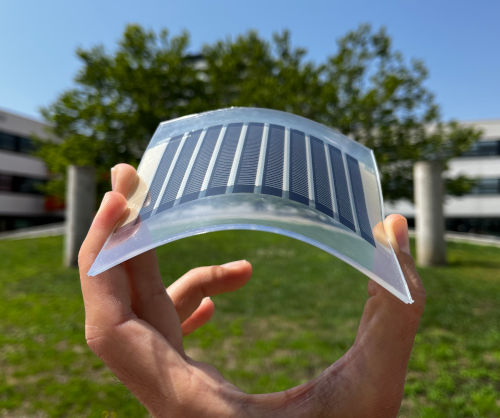
The project, funded by the European Union's Horizon 2020 program, "has paved the way for products with new features, lighter, thinner and more flexible, made up of advanced inks printed on flexible surfaces made of plastic or nanocellulose, which have emerged as a viable alternative to traditional semiconductors, such as copper and silicon," says Paul Lacharmoise, director of the Functional Printing and Integrated Devices Unit at Eurecat.
In the words of MADRAS coordinator and Eurecat project manager Rosa Araujo, “MADRAS has successfully promoted a set of new sustainable materials with improved optical and electrical properties, establishing a high-speed manufacturing methodology that guarantees a scalable and competitive process, promoting the widespread adoption of printed electronic devices.”
In this project , we have worked on the development of conductive and semiconducting materials that allow us to create fully printed devices with exceptional performance and stability,” highlights Laura López, technical coordinator of MADRAS and researcher at the Functional Printing and Integrated Devices Unit of Eurecat. “The electronic devices developed have opened up new possibilities for innovation and commercialization in the fields of logistics, packaging, photovoltaics, and IoT devices, among others,” she adds.
The project has used plastronics technology, which combines functional electronics printing with traditional plastics transformation processes such as thermoforming and injection molding, improving the device integration process.
“This cutting-edge technology has not only increased resistance to moisture and wear, but has also allowed us to add custom-made connectors, further expanding the capabilities of the printed electronic devices,” explains Cristina Casellas, technology promoter at the Functional Printing and Integrated Devices Unit of Eurecat.
Validation in three consumer electronics products:
The advances achieved in the MADRAS project have been validated in the implementation of three printed electronic products integrated into plastic parts. Specifically, a flexible, battery-free geolocation tag has been created for the packaging sector, offering improved tracking and monitoring capabilities; a photosensor-based biometric reader will be used for user identification in electric mobility services; and a flexible photovoltaic module integrated into an injection-molded plastic part opens up multiple integration possibilities.
The MADRAS project has been funded by the European Union's Horizon 2020 program and coordinated by the Eurecat technology center. Eleven other partners are participating, from Spain (Eticas Research and Consulting, TECNOPACKAGING, UNE, and the Cooltra Group), France (Genesink, Fedrigoni, and Paragon ID), Denmark (infinityPV), the Netherlands (TNO), and the Czech Republic (COC and the University of Pardubice).