The new IDTechEx report, "Printed and Flexible Electronics 2023-2033: Forecasts, Technologies, Markets," provides a comprehensive overview of what can seem like a bewilderingly broad topic. Summarizing IDTechEx's extensive portfolio of printed/flexible electronics reports and drawing on years of tracking this evolving industry, the report outlines innovations, opportunities, and trends across five sectors of the printed and flexible electronics market: automotive, consumer goods, energy, healthcare/wellness, and infrastructure/construction/industrial. This analysis includes detailed forecasts for 50 distinct applications and 40 in-depth company profiles.
Furthermore, the report outlines advancements in multiple underlying technologies: six distinct manufacturing methods (including in-mold electronics and flexible hybrid electronics), five material types (including conductive inks and component fixatives), and four component types (including flexible integrated circuits). Numerous recent examples, drawn from industry interviews and conferences, illustrate successful technological development and commercialization directions. Assessments of technological and commercial readiness are also included, along with further forecasts on manufacturing methods and conductive inks.
Application Opportunities:
As with conventional printed circuit boards, printed and flexible electronics have applications in most vertical markets. For example, electronic skin patches already exist that use conductive inks for electrodes and contacts, as well as pressure-sensitive printed insoles for gait monitoring. Compliance is also being applied to automotive interiors, where printed/flexible electronics are used for lighting, heating, and touch interfaces. Organic photovoltaics is experiencing a renaissance, with recent commercial examples including both building integration and indoor energy harvesting. Printed electronics-based sensors for asset monitoring and preventative maintenance promise low production costs and novel form factors to suit specific requirements.
Innovations:
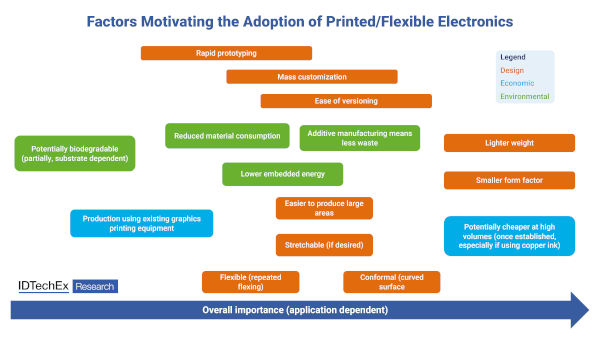
Printed and flexible electronics represent a fundamentally different approach to manufacturing, replacing the subtractive removal of laminated copper with the additive deposition of conductive ink. This reduces waste and facilitates digital manufacturing, with the associated advantages of rapid prototyping and easy design adjustments. The report assesses a range of manufacturing innovations and their prospects, from fully additive 3D electronics to in-mold electronics and new digital printing methods with resolutions as small as 1 μm.
Materials innovation underpins many emerging hardware technologies, and printed electronics is no exception. Conductive inks are the foundation of this technology, with dozens of companies developing inks with varying compositions and attributes. Viscous silver flake-based inks for screen printing are prevalent, but other alternatives, such as nanoparticle and particle-free inks, are gaining traction for specialized applications like electromagnetic interference shielding. One particularly noteworthy trend is the development of copper ink, which promises substantial cost reductions compared to its silver-based counterparts. Other specialized materials include ultra-low temperature solders and field-aligned anisotropic conductive adhesives, which enable the secure attachment of components like LEDs to cheaper, thermally brittle substrates. Furthermore, many sensors require specialized materials, such as printable piezoelectric polymers for vibration sensing and functionalized carbon nanotubes for ion sensing.
While the original vision for printed and flexible electronics was to print all aspects of the circuit, including the integrated circuit, this has been largely superseded by flexible hybrid electronics (FHE), which combines printed and assembled functionality. Thus, it is now possible to create integrated circuits, batteries, and flexible displays natively.
Author: Dr. Matthew Dyson, Principal Technology Analyst at IDTechEx