
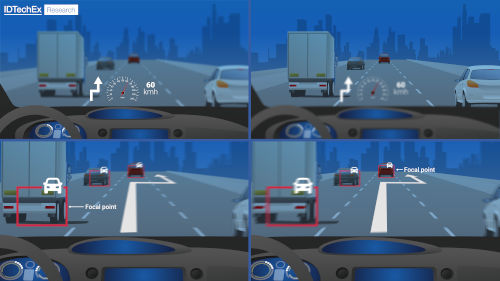
HUDs present these images directly in the driver's line of sight, thus reducing the need for the driver to take their eyes off the road.
This need contributes to increased road safety, which is why the automotive industry considers HUDs a viable option to reduce driver distraction.
The IDTechEx report, "Automotive Heads-up Displays 2024-2034: Technologies, Players, Opportunities," offers comprehensive coverage of this space, from well-known two-dimensional technologies to the most futuristic three-dimensional imaging techniques poised to revolutionize the automotive sector. The report also includes key trends, market analysis, opportunities, and detailed 10-year forecasts for display volume (number of screens) and value (dollars), segmenting the sector by display type, technology, and region.
The currently dominant technology in this field is TFT-LCD, which offers good image quality, durability, and maturity. More importantly, it is also highly scalable and comparatively inexpensive compared to market alternatives. However, it is two-dimensional and lacks depth when highlighting objects on the road when used as a head-up display (HUD). Beyond displaying DAB and vehicle information, HUDs are expected to highlight potential hazards on the road and provide more assistance to drivers. These are also known as augmented reality HUDs (AR-HUDs). Because of this increased immersion, it is important to have a technology that provides depth to images and expands the field of view (FOV) while highlighting key areas of interest on the road.
There are two technologies that allow obtaining three-dimensional images and that are being tested in HUDs: computer-generated holography (CGH) and light field displays (LFD).
Unlike two-dimensional or stereoscopic displays, these 3D technologies project virtual objects with true depth cues. LCD, OLED, and microLED displays are examples of 2D technologies that display images directly onto a flat surface. Sometimes, they are used to create a 3D illusion, where a 2D image is shown to the left eye and a slightly different image is shown to the right eye. This is known as the parallax effect. However, the widespread use of these 2D techniques to display 3D images induces an effect known as vergence-accommodation conflict (VAC). VAC is the disparity in distance between the virtual object and the eye. For example, a virtual object might be displayed 3 meters from the eye, but the eye naturally focuses on a screen located a few centimeters away. This distance discrepancy causes discomfort and nausea in the user, who cannot use these stereoscopic displays for extended periods.
Therefore, several companies and research groups are evaluating the use of 3D visualization technologies such as holography and LFDs.
Holography, in particular, seems to be gaining more appeal when applied to automotive HUDs, and there are some notable reasons for this growing interest.
The first point, already discussed, relates to its ability to project virtual images with true depth cues and no loss of resolution. The driver's experience is much more comfortable when road obstacles are indicated with images that have depth. Much like our everyday vision, we can focus and defocus virtual objects seamlessly, something that is not easy to achieve with 2D technologies. The various depth cues offer a more comfortable driving experience and can be particularly useful for highlighting road obstacles that naturally have varying depths.
Secondly, brightness is fundamental in HUDs. A display technology that performs well in varied environmental conditions is essential, as key information must be visible in both bright light and darkness. CGH uses a coherent light source, typically a laser. Lasers are inherently very bright and perform well in a wide range of ambient light environments.
Companies specializing in holographic HUDs are focusing on two key aspects to compete with the dominant TFT-LCD technology: reducing the cost of these devices and miniaturizing their form factor. Currently, their larger size and higher cost make these devices suitable only for the largest and most expensive vehicles, also known as premium vehicles. To be more competitive in this market and realize its great potential, both the cost and the form factor must decrease.
Although holographic technology is considered suitable for automotive HUDs, its image quality is comparatively inferior to that of LCD and OLED displays, mainly due to an effect known as mottling, meaning it requires greater maturity to be adopted in other long-term applications.
Author: Dr. Xiaoxi He, Research Director at IDTechEx