Researchers have optimized a process for recovering high-purity silver and silicon, facilitating its industrial scaling. This will reduce the consumption of raw materials and energy, promoting the recycling of solar modules, which are essential for a sustainable energy system.
Until recently, the recycling of photovoltaic modules was a minor concern in the sector given the still limited penetration of solar energy worldwide. However, the spectacular increase in installed capacity in recent years, along with growth forecasts for the coming decades, anticipates a scenario in which an increasing number of end-of-life modules will be decommissioned approximately 25 years after installation. The most conservative forecasts reveal that around 400 million modules will have been decommissioned by 2030, a figure that will exceed 10 billion by 2050.
A photovoltaic module consists of a string of interconnected solar cells embedded in polymer sheets and bonded to glass for protection from external elements (humidity, ultraviolet radiation). The glass, along with an aluminum frame, also provides rigidity to facilitate installation and resistance to impacts, wind loads, etc. In a way, designing the module to be resistant to degradation and aging, and to guarantee its operation for decades, makes the separation and recovery of materials difficult once it has reached the end of its useful life.
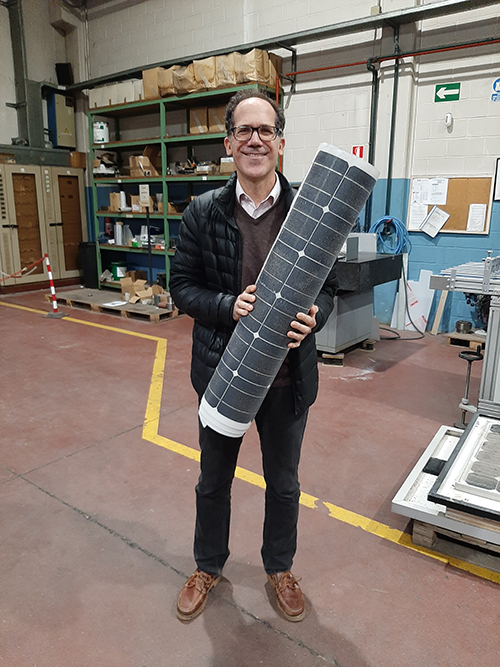
The lead researcher holding a rolled-up sheet of encapsulated solar cells after separating them from the front glass. Author: David Fuertes Marrón.
Currently, many methods are being proposed for recycling solar modules using mechanical, thermal, or chemical approaches. Some have reached a high level of development, for example, those aimed at the heavier module components, such as the glass and the aluminum frame. However, this level of development has not yet been achieved for the metal contacts and silicon that make up the solar cells, which are the most demanding elements in terms of energy consumption and environmental impact. Furthermore, the quality of the recovered materials is often insufficient for reintroduction into the photovoltaic value chain.
Within the framework of the RESILIENS project, funded by the Spanish State Research Agency (AERIS) through its call for proposals for Ecological and Digital Transition (TED) projects, four institutions are collaborating to establish a feasible, cost-effective, and sustainable technology that will allow the recovery of silicon and metals from discarded photovoltaic devices and their reuse in the manufacture of new solar cells. Coordinated by researchers from the Solar Energy Institute of the Polytechnic University of Madrid (UPM), the project also includes researchers from the Department of Chemical Engineering at the Complutense University of Madrid (UCM), the Faculty of Sciences at the Autonomous University of Madrid (UAM , and IMDEA Nanociencia.
“The project results to date validate our strategy,” says Carlos del Cañizo, a researcher at IES-UPM who leads the project. “We have optimized a demetalization process that recovers silver in the solid state and achieves an optimum between metal recovery and preservation of the silicon substrate. We have also demonstrated that reinjecting the silicon during the crystallization stage guarantees obtaining silicon with sufficient purity to manufacture high-efficiency solar cells, in a process that adapts the properties of the resulting silicon to current industry requirements, transforming, for example, multicrystalline silicon into monocrystalline silicon,” the researcher explains. The processes use methods and components well-known in the photovoltaic industry (alkaline etching for metal recovery, Czochralski growth for silicon recrystallization), so scaling up the results and transferring them to industry can be straightforward. “There is still work to be done to demonstrate the validity of the proposed methods for the wide variety of cell technologies available on the market, as well as to analyze their compatibility with the encapsulants used in the industry,” concludes Carlos del Cañizo, principal investigator of the project.
The RESILIENS project will have a direct impact on reducing the processing of raw materials and energy consumption and will facilitate the recycling of a commercial product, the solar module, which will soon become ubiquitous as a main source of sustainable energy production.
Marcos Tierno, Julia Hernández Ruiz, Sergio Taboada, Eduardo Díez, Araceli Rodríguez, Luis Jaime Caballero, Nerea Dasilva Villanueva, David Fuertes Marrón, Nikolay V. Abrosimov, Carlos del Cañizo. Validation of recycling processes for demetallisation and recrystallisation of silicon solar cells. Solar Energy, Volume 274, 2024, 112533, ISSN 0038-092X, https://doi.org/10.1016/j.solener.2024.112533 .