




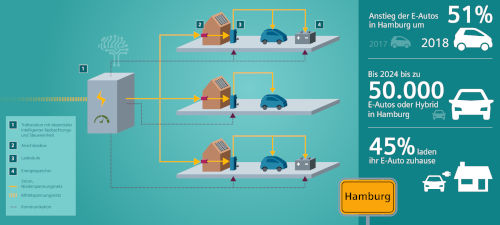
An information resilience concept and communication technology have been applied to digitize secondary distribution networks. The project aims to facilitate the stable and reliable operation of low-voltage networks to ensure a secure energy supply, as demanded by the ever-expanding electric vehicle charging infrastructure.
Hamburg is also pursuing the expansion of electric mobility and the development of a supporting charging infrastructure. As the operator responsible for the distribution network, Stromnetz Hamburg must ensure the safe and reliable operation of the network and, in turn, allow residential charging stations to be integrated into the grid while maintaining specific voltage ranges. Until now, home charging stations have generally been integrated without external control or intervention. As a result, distribution networks suffer, reaching their capacity limits when a large number of electric cars are charged simultaneously, especially during peak demand periods such as the end of the workday. Currently, the capacity limits of existing networks can only be overcome by increasing cable lengths and replacing transformers and switching equipment. However, this requires costly construction and labor measures and can also negatively impact the quality of urban life. In response to this situation, Stromnetz Hamburg and Siemens are collaborating to develop a digital solution. By intervening with control and regulatory measures, low-voltage network operators can take advantage of the flexibility of domestic charging stations to relieve pressure on the network, for example, by distributing the load.
“The requirements for future distribution networks are constantly increasing due to the growing energy demand resulting directly from electric mobility,” said Thomas Volk, Managing Director of Stromnetz Hamburg. “We must be able to cope with this situation and make our network smarter and more flexible, especially at the low-voltage level. A high degree of digitalization is the only way to be reasonably prepared to deal with occasional capacity bottlenecks. The pilot project with Siemens allows us to thoroughly test this technology before launching it—or similar solutions—more broadly abroad. Our customers must be able to meet their evolving mobility needs and rely on a stable and secure energy grid in the future.”
“We are very pleased to be able to implement this future-oriented pilot project together with Stromnetz Hamburg,” said Michael Schneider, Head of Software and Consulting for Digital Grid at Siemens Smart Infrastructure. "The rapid growth of electric mobility in cities like Hamburg will place heavier loads and greater high-power demands on the low-voltage network, potentially leading to network overloads. Intelligent and decentralized monitoring and control of private charging equipment on the secondary distribution network will help provide a quick and cost-effective solution for distribution network operators, enabling them to maintain the high reliability of their networks."
The project is divided into three phases. The first stage involves testing the operations management concept at the Stromnetz Hamburg innovation campus. In the second phase, the findings will be field-tested on the public network, allowing for further refinement of the concept. Finally, preparations will be made for the deployment of a production solution for the control and connection units.
A digital secondary distribution network is configured as follows: an intelligent monitoring and control unit is installed at the secondary substation as a decentralized intelligence. It monitors the low-voltage network and transmits setpoints to the home charging station in case of overload situations, instructing the station to reduce its charging power. The equipment communicates via Powerline Communication and ensures that no personal data or data that could be used to draw conclusions about the vehicle owner's behavior is used. The solution is designed to operate autonomously, so no communication with a central system is required during operation, allowing for its selective deployment within the distribution network. The use of self-learning processes minimizes commissioning costs, as well as the costs associated with maintaining the digital secondary distribution network.
The digital secondary distribution network will help maintain voltage in the low-voltage network and prevent overloads. This will be an important factor in stabilizing the grid, not only as electric mobility expands, but also when electricity comes more from renewable energy sources, such as solar photovoltaics or the increased use of heat pumps. In this way, the digital secondary distribution network plays a key role in the transition to a new energy mix and the decarbonization of the energy and transportation sectors.













