Ultra-thin films could replace the heavy, energy-intensive components of today's loudspeakers, lightening the systems and making them more environmentally sustainable. This would not only make life easier for stage technicians and operators who have to stack towers of speakers in stadiums and concert halls, but could also reduce electricity demand in millions of homes. The magnetic transducers in PA and stage loudspeakers consume a lot of electricity. It's not uncommon for power levels to reach hundreds of thousands of watts at large-scale events. But the energy consumption of home surround sound installations (music systems or home theaters) is also considerable. Most of us know how quickly a battery-powered (wireless) speaker needs to be recharged.
But the new technology developed by Professor Stefan Seelecke and his research team at the Intelligent Materials Systems Laboratory at Saarland University and ZeMA (Center for Mechatronics and Automation Technology) in Saarbrücken is far more energy-efficient. Their technology doesn't rely on expensive and hard-to-obtain materials; all it needs is a silicone film, some carbon black, and an intelligent control unit. These new film-based drive systems offer the possibility of creating speakers with entirely new shapes. Our intelligent material systems made from dielectric elastomers open up the possibility of rethinking much of what we know in the field of acoustics. “These systems could help make loudspeaker technology more sustainable and develop it in new directions,” said Professor Stefan Seelecke.
The range of potential applications is very broad. For example, the films could be integrated into wall-mounted textiles to actively cancel ambient noise, or if worn on the body, they could emit acoustic signals. The research team from Saarbrücken will present its technology at this year’s Hannover Fair, where they will seek commercial and industrial partners with whom to research and develop the technology for new applications.
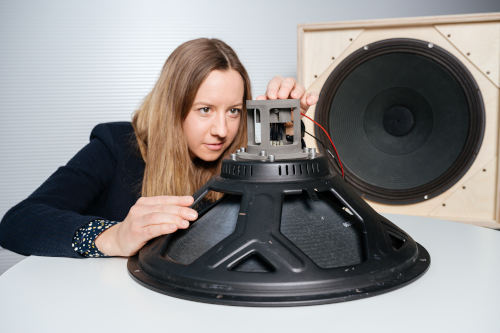
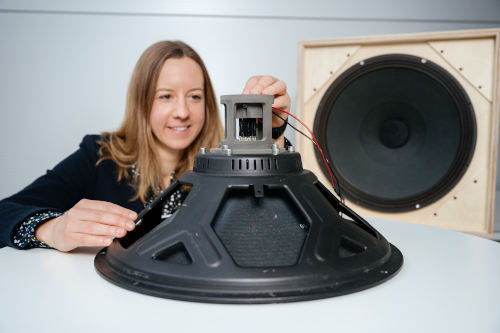
The technology is based on thin silicone films coated with an electrically conductive layer to create dielectric elastomers that require only very low levels of electrical energy to operate. By varying the applied electric field, the research team can make the elastomer vibrate at high frequencies or perform continuously variable bending movements. If the elastomeric film is rolled up, it can be used as a new type of loudspeaker driver, replacing the heavy, energy-intensive electromagnets or permanent magnets that drive diaphragms. "The speakers deliver rich bass frequencies.
 A highly flexible carbon black-based electrode layer is printed on both sides of the silicone film," explains Professor Paul Motzki, who researched this field as a postdoctoral fellow in Seelecke's team. “If we apply a voltage to the elastomer, the electrodes attract each other, compressing the polymer and causing it to expand laterally, thus increasing its surface area,” explains Motzki, who is now an interinstitutional professor of smart material systems for innovative production at Saarland University and ZeMA, where he heads the “Smart Material Systems” research area. Because they contract in this way, the polymer sheets have also been dubbed artificial muscles. And every time they change shape, so does the film’s electrical capacitance. Each capacitance value corresponds to a specific position of the sheet. The film thus becomes its own sensor. By combining the measurement data with intelligent algorithms, the team can program extremely fast movement sequences and thus precisely control the elastomer film’s behavior. By altering the applied electric field, the researchers can make the film pulse, oscillate, or flex at the desired frequency.
The film can also be made to generate single or even multiple acoustic tones if several are superimposed. vibration frequencies, which turns the elastomeric film into its own speaker. Depending on the application, we can use the film as both a drive system and a sound generator. We can develop technical solutions with novel shapes and designs that are also incredibly compact, just a few millimeters thick,” explains Sophie Nalbach, who worked on smart films as part of her doctoral thesis in Professor Seelecke’s group and is now a group leader in the “Smart Materials Systems” research area at ZeMA. Although the films do not displace enough air to match the performance of current conventional speakers, they could be incorporated into fabrics capable of emitting acoustic warning signals.
Background:
The technology presented here has been studied and developed in several doctoral research projects. The results have been published as articles in various scientific journals. The research work has also received support from numerous sources. For example, the government of the Saarland federal state provided financial support through the BEAT project, a collaborative project with the Saarland-based company Stamer GmbH, and through the ERDF (European Regional Development Fund) iSMAT project. EU funding was provided through a Marie Curie research grant.
Professor Seelecke's team is currently working on several research projects aimed at developing these sheet-based drive systems for various applications, including how to interconnect them so they can communicate and cooperate collectively. To achieve this, the researchers will need to equip the surfaces and interfaces with new capabilities, which in turn requires further miniaturization of the technology.