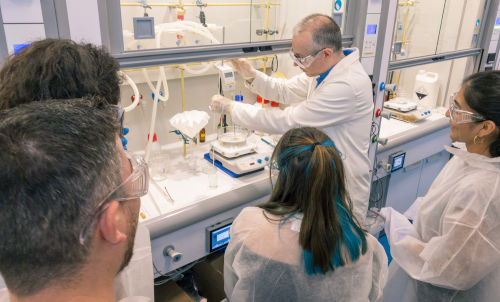
The available positions and application form can be found on the project website.
D-CARBONIZE brings together a consortium of 12 partners led by Prof. Arjan W. Kleij of the Catalan Institute of Chemical Research (ICIQ). “Our goal is to create plastics with similar or even better functionalities using biomass as one of the starting materials. In a few years, the coating on our smartphones or any other consumer product could be made from recycled materials,” explains Prof. Kleij.
Belén Monje, lead researcher in Mechanochemistry and Reactive Extrusion at the Technological Institute of Plastics (AIMPLAS), highlighted that “the project is a great opportunity for doctoral students to enter the field of biomass valorization for the development of biomonomers and biopolymers using different batch and reactive extrusion technologies, with catalysis being a key element, as well as the chemical recycling of the resulting polymers.”
Students participating in this network will receive a dual doctoral degree from two of the six universities involved in the project. Over a three-year period, beginning in September 2023, they will receive comprehensive training that will enable them to understand and design new bioplastics value chains. This cross-disciplinary training will allow students to use catalysis as a key driver for the generation of monomers, polymers, and sustainable materials within the value chain.
The innovative aspect of the training lies in the execution of a partial project at two different host institutions, while another part will take place in industry itself, through internships at one of the five companies participating in the network. This way, students will be exposed to commercial requirements, industrial facilities, process scale-up, as well as safety and economic assessments.
The consortium consists of six beneficiaries: the Catalan Institute of Chemical Research (ICIQ), the University of Liège, the University of Groningen, the French National Centre for Scientific Research (CNRS), the University of Heidelberg (UHEI), and AIMPLAS, which will mentor the students. The team is further complemented by five companies that will host the students' short-term internships: BASF, Total Energies, Corning, Polykey Polymers, and Celabor SCRL. The non-governmental organization CO2 Value Europe supports dissemination and training activities, while the partner universities Universitat Rovira i Virgili, the University of Rennes and the Universitat Politècnica de València will contribute double doctoral degrees.
New Solutions for Biocarbon Valorization:
The overall idea behind the project is to minimize the carbon footprint of plastic materials through a dual approach. This involves designing recyclable polymers that, once they reach the end of their useful life, can be reused in new applications. The use of biomass and carbon dioxide will reduce the industry's dependence on petroleum-derived carbon in plastic production.
The D-CARBONIZE team will use various types of biomass, including glycerol from the biodiesel industry, as well as terpenes and sugars from plant or fruit waste, to produce monomers, polymers, and plastic materials through catalytic transformations. Once this is achieved, the consortium members will strive to recycle the polymers back into their monomeric form or provide new starting points for polymer development, thus creating a circularity of atoms.
The D-CARBONIZE project is funded by the European Union within the HORIZON-TMA-MSCA-DN Programme under Grant Agreement No. 101073223.