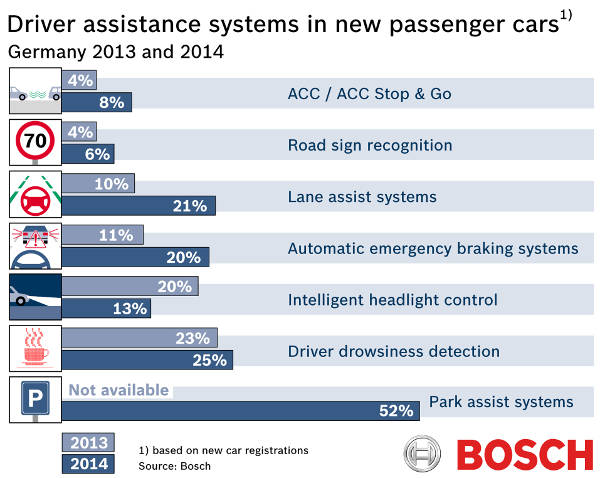
According to a Bosch assessment based on 2014 statistics, one in ten newly registered passenger cars in Spain was equipped with this type of driver assistance system last year. In Spain, according to a joint study by Bosch and the RACC (Royal Automobile Club of Catalonia), automatic emergency braking, in its various versions, could prevent one in five traffic accidents and save up to 272 lives. According to Bosch's accident research, lane-keeping assist systems could prevent up to 28 percent of accidents resulting in injuries caused by drivers accidentally leaving their lane.
The added safety provided by driver assistance systems is one of the key reasons for their growing popularity. Automatic emergency braking systems are also benefiting, in particular, from the new Euro NCAP assessment system. From 2016, car manufacturers aiming for the highest five-star rating will be required to include a predictive pedestrian protection function in their new vehicles. Encouraged by changes in testing specifications and driven by decreasing costs, an increasing number of passenger cars are being equipped with sensors that monitor their surroundings.
 With its medium-range radar (MRR) sensor, Bosch has made radar technology affordable for the mainstream market. The MRR can already be found in cars in the supermini and compact segments. This is significant because a single sensor can underpin several driver assistance systems. In addition to automatic emergency braking, the MRR also enables adaptive cruise control (ACC). ACC automatically maintains both the driver's selected speed and the programmed safe distance from the vehicle ahead. When combined with a forward collision warning system, ACC could reduce the number of sudden braking incidents on highways by 67 percent. It can also reduce collisions involving vehicles traveling very close to each other by up to 73 percent. The installation rate of ACC in 2014 reached only one percent of all newly registered cars in Spain.
The number of new vehicles equipped with a driver fatigue detection system reached 12 percent of newly registered cars in 2014. The Bosch system uses the steering angle sensor and electric power steering to constantly analyze the driver's steering behavior, looking for typical signs of drowsiness. The system immediately registers abrupt steering maneuvers and, when combined with other parameters such as driving time and time of day, identifies the onset of drowsiness. Before the driver begins to nod off at the wheel, the fatigue detection system warns them to stop and rest.
Three percent of all cars registered last year are capable of recognizing certain roadside traffic signs with the help of a video camera. The information displayed on the dashboard screen, using the corresponding symbol, helps drivers navigate the complex network of traffic signs more safely.
Automatic emergency braking systems are more common in Belgium. One in four newly registered passenger cars in this country helps drivers brake when they encounter an obstacle, compared to one in five in Germany. In the Netherlands, 17 percent of new cars are equipped with this type of assistance, while the same system is present in 11 percent of new vehicles registered in Spain and 5 percent in the United Kingdom. A look at the other EU countries regarding the rate of lane-keeping assist systems is that 21 percent of new cars registered in Germany were equipped with such a system in 2014, 14 percent in Belgium, 11 percent in the Netherlands, 9 percent in Spain, and 6 percent in the United Kingdom.