




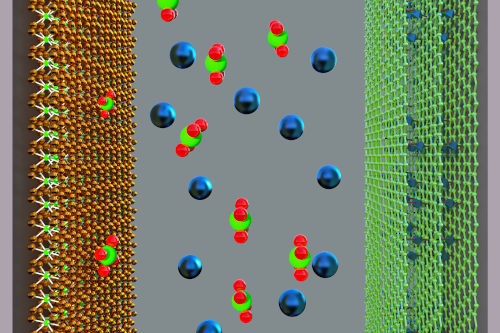
Energy storage is usually associated with batteries and accumulators that power electronic devices. However, these days, so-called supercapacitors are increasingly being installed in laptops, cameras, mobile phones, and vehicles.
Unlike batteries, these can rapidly store large amounts of energy and release it just as quickly. If, for example, a train brakes as it enters a station, the supercapacitors store the energy and release it again when the train needs a surge of power immediately upon starting.
However, one problem with supercapacitors to date has been their lack of energy density. While lithium batteries achieve an energy density of up to 265 kilowatt-hours (kWh), supercapacitors have so far only offered about one-tenth of that.
 The sustainable material provides high performance
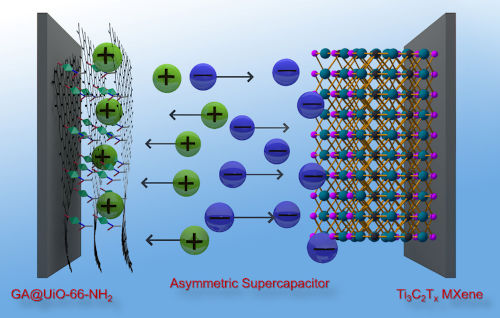
The team working with TUM chemist Roland Fischer has now developed a novel, powerful, and sustainable graphene hybrid material for supercapacitors. It serves as the positive electrode in the energy storage device. The researchers are combining it with a proven negative electrode based on titanium and carbon.
The new energy storage device not only achieves an energy density of up to 73 Wh/kg, roughly equivalent to the energy density of a nickel-metal hydride battery, but also performs significantly better than most other supercapacitors with an energy density of 16 kW/kg. The secret of the new supercapacitor lies in its combination of different materials, which is why chemists refer to it as an "asymmetric" supercapacitor.
Hybrid materials: Nature is the role model
Researchers are betting on a new strategy to overcome the performance limits of standard materials: they are using hybrid materials. "Nature is full of highly complex, evolutionarily optimized hybrid materials—bones and teeth are examples. Their mechanical properties, such as hardness and elasticity, were optimized by nature through the combination of various materials," says Roland Fischer.
The abstract idea of combining basic materials was transferred to supercapacitors by the research team. As a foundation, they used the novel positive electrode of the storage unit with chemically modified graphene and combined it with a nanostructured metal-organic framework, a so-called MOF.
Powerful and stable
Crucial to the performance of graphene hybrids are, on the one hand, a large specific surface area and controllable pore sizes, and on the other hand, high electrical conductivity. "The material's high-performance capability is based on the combination of microporous MOFs with conductive graphene acid," explains first author Jayaramulu Kolleboyina, a former visiting scientist working with Roland Fischer.
A large surface area is important for good supercapacitors. It allows the collection of a relatively large number of charge carriers within the material – this is the basic principle for storing electrical energy.
Through skillful material design, researchers achieved the feat of combining graphene with MOFs. The resulting hybrid MOFs have a very large internal surface area of up to 900 square meters per gram and are highly effective as positive electrodes in a supercapacitor.
Long-term stability
However, that's not the only advantage of the new material. To achieve a chemically stable hybrid, strong chemical bonds between the components are needed. The bonds are apparently the same as those of amino acids in proteins, according to Fischer: "In fact, we've linked graphene acid with an amino acid MOF, which creates a type of peptide bond.".
The stable connection between nanostructured components has huge advantages in terms of long-term stability: The more stable the bonds, the more charge and discharge cycles are possible without a significant deterioration in performance.
For comparison: A conventional lithium battery has a lifespan of about 5,000 cycles. The new cell developed by TUM researchers retains nearly 90 percent of its capacity even after 10,000 cycles.
International network of experts
Fischer emphasizes the importance of the unrestricted international cooperation that the researchers themselves controlled when it came to developing the new supercapacitor. Consequently, Jayaramulu Kolleboyina built the equipment. He was a visiting scientist from India, hosted by the Alexander von Humboldt Foundation, and is now the head of the chemistry department at the newly established Indian Institute of Technology in Jammu.
"Our team also engaged with experts in electrochemistry and battery research in Barcelona, as well as with experts in graphene derivatives from the Czech Republic," Fischer reports. "In addition, we've brought on board partners from the US and Australia. This wonderful international cooperation holds great promise for the future."
Publication:
Jayaramulu Kolleboyina, Michael Horn, Andreas Schneemann, Aristides Bakandritsos, Vaclav Ranc, Martin Petr, Vitalie Stavila, Chandrabhas Narayana, Błażej Scheibe, Štěpán Kment, Michal Otyepka, Nunzio Motta, Deepak Dubal, Radek Zboril and Roland A. Fischer
Covalent Graph-MOF Hybrids for Supercapacitors Asymmetric High Performance
Advanced Materials, 4.12.2020 - DOI: 10.1002/adma.202004560
https://onlinelibrary.wiley.com/doi/full/10.1002/adma.202004560
More information:
The research was supported by the German Research Foundation (DFG) within the e-conversion group of excellence, the Alexander von Humboldt Foundation, the Indian Institute of Technology Jammu, Queensland University of Technology, and the Australian Research Council (ARC). Additional funding came from the European Regional Development Fund, provided by the Ministry of Education, Youth and Sports of the Czech Republic.













