




Abundance of minerals
Sodium-ion batteries offer a key advantage in terms of mineral abundance. Lithium prices soared to over US$80,000 per ton in 2022 due to geopolitical tensions, post-COVID supply issues, and increased demand. This highlighted the fragility of a supply chain dominated by China, which controls over 93% of graphite processing and over 80% of global gigafactory production.
Although lithium prices have since fallen to around US$10,000 per ton, sodium carbonate remains significantly cheaper. This translates to a lower material bill and less exposure to supply disruptions. Sodium is also widely available and can be obtained from common materials such as trona or salt, making it an ideal candidate for domestic production.
The IDTechEx report, “Sodium-ion Batteries 2025-2035: Technology, Players, Markets and Forecasts,” concludes that if lithium prices rise again above US$50,000 per ton, the cost advantage of sodium-ion batteries will become even more pronounced.
Immediate compatibility
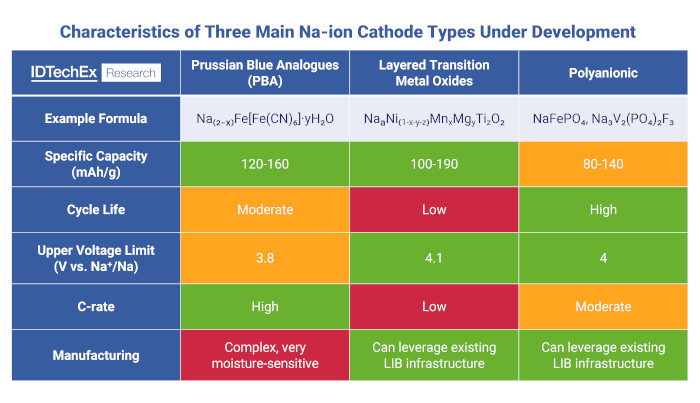
Sodium-ion batteries offer high compatibility with existing lithium-ion battery manufacturing processes. They can often be manufactured using the same form factors and equipment, enabling faster and more cost-effective scale-up. However, compatibility is dependent on the chemistry. Some materials, such as layered oxides and Prussian blue analogs, are sensitive to humidity and require handling in dry rooms to prevent performance loss from reactions with water vapor.
Sodium-ion cells also have a lower energy density, meaning more cells are needed to store the same amount of energy. This increases equipment requirements and raises processing costs by approximately 15%. Even so, sodium-ion cells can leverage much of the lithium-ion supply chain, with shared processes and infrastructure offering a valuable shortcut to industrial scale.
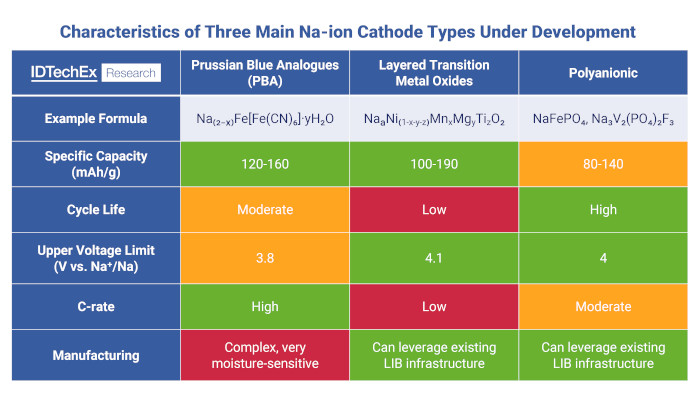
The compatibility of sodium-ion and lithium-ion cell production depends on the chemistry. Source: IDTechEx
Security advantages
Sodium-ion batteries can be transported with a zero state of charge, unlike lithium-ion cells. This reduces the risk of fire during transport and makes shipping safer, easier, and cheaper. This is a key logistical advantage, especially for global supply chains.
Sodium-ion batteries typically use hard carbon anodes. Because sodium is not intercalated within the graphite, this allows the use of different electrolyte solvents, such as propylene carbonate (PC), which has a high flash point and a wide liquidity range. While generally unsafe in lithium-ion systems, it works well in sodium-ion cells. PC can replace more flammable solvents, such as DEC and DMC, improving thermal stability and safety.
That said, the general assertion that sodium-ion batteries are always safer than lithium-ion batteries is not entirely accurate. Safety depends heavily on the specific chemistry used. For example, layered oxide materials such as NFPP or NFM behave differently under improper use conditions. These differences are discussed in more detail in the full IDTechEx report, which includes ARC test data from several sodium-ion battery developers.
In situations of thermal abuse, sodium-ion cells tend to enter thermal runaway at higher temperatures and progress more slowly than lithium-ion cells, offering additional safety under certain conditions.
Author: Shazan Siddiqi, Principal Technology Analyst at IDTechEx













