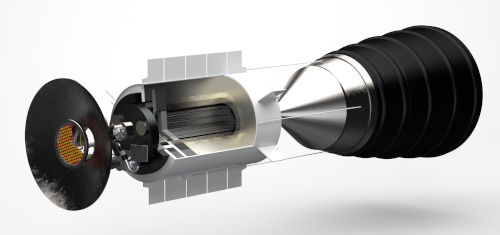
In this context, the Tekniker technology center, a member of the Basque Research and Technology Alliance (BRTA), is investigating the advantages of using nuclear thermal propulsion in engines compared to classic propulsion systems and highlighting its potential cost-effectiveness.
“The state of the art is very limited or in some cases completely confidential due to the novelty of the technology. Obtaining all the necessary information has been a challenge, as has understanding all the technological concepts, techniques to apply, operating environment, and needs to achieve a thermonuclear propulsion system suitable for space exploration missions,” highlights Borja Pozo, researcher and head of the space sector at Tekniker.
The researcher from the technology center will present the first results at the Space Propulsion 2024 international congress.
Specifically, the first results in the design of the engine reactor to maximize its efficiency and maintain safety will be presented, along with the materials, systems and technologies required for a thermonuclear propulsion-based rocket, the test benches that will be required, and the analysis of possible missions to Mars with astronauts calculating trajectories and correction maneuvers.
Tekniker's research on thermonuclear propulsion technology is part of the HIPERION II project, funded by the Basque Government, which aims to generate knowledge and capabilities for new space technologies and future planetary missions. The initiative stems from technological developments carried out in the HIPERION project, in which Tekniker also participated.
In this case, Tekniker's initiative focuses on Nuclear Thermal Propulsion (NTP), which in practice consists of using a fission reaction to heat and accelerate a coolant (liquid hydrogen) at high speed.
“The main advantage over the chemical reaction is that the heating process doesn't require any oxidant, which increases thrust efficiency by maintaining a lower exhaust gas density. For a 10-ton thrust engine, for example, the efficiency is expected to be two to three times greater than that of cryogenic chemical propulsion,” Pozo explains.
This propulsion system also significantly shortens the duration of a trip to Mars from the current 7-8 months to just 3, thus reducing the crew's exposure to cosmic radiation and providing a safer journey. At the same time, it will allow for a reduction in the costs of interplanetary travel.
Finally, Tekniker is defining an action plan for the development of the thermonuclear propellant based on five phases including nuclear and non-nuclear systems/components: technology maturation; development of subscale components and non-nuclear testing; the development of the engine itself, full-scale integration and testing, and the manufacturing and assembly of flight engines on future orbiting rockets and associated stage systems.