This will create a new battery market that, according to the new IDTechEx report "Battery Markets in Construction, Agriculture & Mining Machines 2024-2034", will grow to a value of $7.8 billion, with a constant 10-year annual growth rate of 27.1% and an annual demand of more than 50 GWh in 2034.
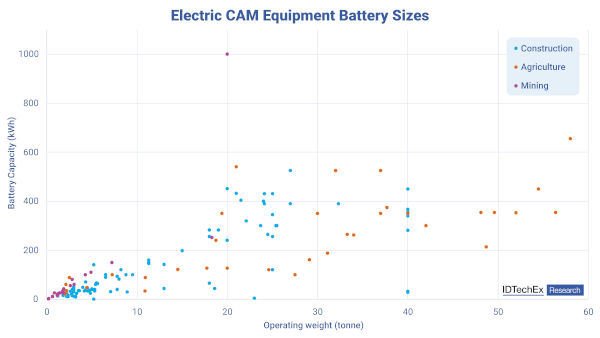
Wide range of battery sizes needed in the CAM market. Source: IDTechEx
The CAM industry is a bit late to the electrification party, but this means it benefits from a thriving and established electrification supply chain, courtesy of the automotive industry. In the early days of automotive electrification, two factors drove battery development: energy density for range and battery cost. Thus, the electric vehicle industry favored nickel manganese cobalt (NMC) and lithium ferrous phosphate (LFP) batteries, which offer a balanced solution to these two factors. However, a new market research report from IDTechEx concludes that CAM machines have a wide variety of needs, creating opportunities for battery technologies beyond the established automotive landscape.
Many battery technologies are coming onto the market today, from evolutions of lithium-ion technology to revolutionary sodium-ion options. Each technology has its pros and cons; for example, lithium titanate (LTO) batteries offer a lifespan ten times longer than other batteries, but have half the energy density. Or batteries that use silicon instead of graphite in the anode offer exceptional energy density and high power capacity, but suffer in cycle life. Like most things in life, there are trade-offs; there is no perfect solution that offers the best energy density, power, longevity, cost, and safety all in one package. Fortunately, at CAM, there are often machine types with needs that align with the advantages and disadvantages of current battery options.
Haulage trucks are a good example of a CAM machine with highly specialized needs. These gigantic machines, weighing over 150 tons, are used to transport raw materials extracted from mines around the world. Their uptime is enormous, as they typically operate for more than 20 hours a day, 360 days a year. Due to their weight and operating time, they require large batteries to perform their work. IDTechEx has seen batteries of up to 2 MWh in these machines. To put that into perspective, 2 MWh is equivalent to 20 Tesla Model S batteries or 50 Nissan Leaf batteries (40 kWh each). A battery of this size would weigh around 10 tons and would likely cost between $500,000 and $1 million. Fortunately, given that the machine already weighs so much and carries payloads of hundreds of tons, the size and weight of the battery are not critical; in fact, the engines that the electric powertrain replaces already weigh between 10 and 25 tons.
For an electric haul truck, IDTechEx identifies three main priorities that the chosen battery type must meet:
1. It must be capable of fast charging to provide the uptime these machines require.
2. It must have a long lifespan. IDTechEx estimates that a haul truck will go through 12,000 charge cycles over its lifetime.
3. It must make economic sense. Some battery technologies would not last 12,000 cycles, necessitating costly replacements. Some technologies might reach that lifespan, but they typically cost a bit more.
Taking these priorities into account, the IDTechEx report concludes that LTO is a great option for freight trucks. LTO is a very reliable technology, and the packs available from turnkey battery pack assemblers, such as Forsee Power, ABB, and Voltabox, have a lifespan of between 20,000 and 100,000 cycles. Furthermore, it performs very well at fast charging, with many examples capable of charging in 6 minutes or less. Of course, LTO does have its drawbacks: its energy density is roughly half that of LFP options, and it is more expensive per kWh. However, neither of these factors is particularly important for freight trucks. They are large enough to handle the added weight, while the longevity of LTO batteries eliminates the need for replacements, more than offsetting their additional cost.
However, large batteries and fast-charging capabilities pose another problem: charging. If a 2 MWh battery were to charge in 6 minutes, it would require a 20 MW grid connection. This energy demand is so high that it would require approximately six dedicated offshore wind turbines to charge it. Solutions to these charging needs are being explored, a topic analyzed in the IDTechEx report, "Off-Grid Charging For Electric Vehicles 2024-2034: Technologies, Benchmarking, Players and Forecasts.".
The CAM industry is full of machines like this. Machines that have a specific set of needs for their specialized use cases. Mini excavators have small chassis that require solutions similar to those in the automotive industry. Large loaders require large, inexpensive batteries, which may create a market for sodium-ion solutions. In agriculture, chassis space is more limited, but seasonal use means fewer cycles are needed, which could open the door to silicon anode technologies.
Author: Dr. James Jeffs, Senior Technology Analyst at IDTechEx