Now that the sector has received significant funding and crucial support from governments and regulators, it is imperative that they demonstrate their commitment to decarbonizing aviation. In 2023, several new electric aircraft successfully demonstrated their technology. However, significant challenges lie ahead. Regulators must ensure safety and establish clear flight standards, while the public must be convinced of the sustainability and social benefits of electric aircraft.
The IDTechEx report, "Air Taxis: Electric Vertical Take-Off and Landing (eVTOL) Aircraft 2024-2044: Technologies, Players," predicts that eVTOL unit sales will show a CAGR of 25% for the period 2024-2044. The IDTechEx research also indicates applications where eVTOL aircraft could provide faster, more direct, and more flexible travel at a lower cost than competing modes of transportation. Here's what to expect from the eVTOL market in 2024 and beyond.
Changes in the market landscape
It is highly unlikely that even 10% of the current 300 eVTOL manufacturers will achieve certification and production, let alone become profitable. According to an IDTechEx study, within ten years there will be fewer than 25 commercial eVTOL manufacturers (~5%). By 2024, companies that have not raised sufficient capital during the period of abundant investment funding may face difficulties. Delayed timelines for market entry make securing funding more challenging. Finally, raising money for aircraft development will become more difficult, especially once the major players begin commercial operations.

eVTOL OEMs will have to weather a more challenging investor climate. Source: IDTechEx
Chinese manufacturers eHang and Autoflight are poised to become the first commercial operators of eVTOL aircraft. Looking west, among the leading companies with eVTOL aircraft rated at a high TRL (Technical Readiness Level) and likely to reach the market before their competitors are Archer (Midnight), Beta Technologies (ALIA), Lilium (Jet), Volocopter (Volocity), and Joby Aviation (S4). The first-mover advantage is vital for any of these players, as further benefits will follow: revenue from the first commercial flights will improve their finances and attract additional funding.
Advances in battery technology
The batteries in eVTOLs must provide high power for extended periods to enable vertical takeoff, be light enough to withstand reasonable flight times and payloads, demonstrate good durability to ensure a long service life, and meet the most stringent commercial aviation safety standards. In short, AAM batteries must do a great deal to enable electric flight.
Batteries used in automotive and other commercial applications have not been optimized to meet the right balance of safety, power, energy, lifespan, charging time, and cost requirements for eVTOLs. Although many existing and emerging battery technologies can be applied to eVTOLs, dedicated research and development continues to unlock the potential of battery-powered electric flight. While automotive battery development focuses primarily on cost reduction, the eVTOL sector is actively working to reduce battery weight while simultaneously increasing power and energy.
Aviation batteries will improve dramatically in the coming years; IDTechEx anticipates a 2-3% annual improvement in energy density. Battery cell development has advanced rapidly in recent decades, and cells with energy densities of >300 Wh/kg and power densities of >3 kW/kg are now available.
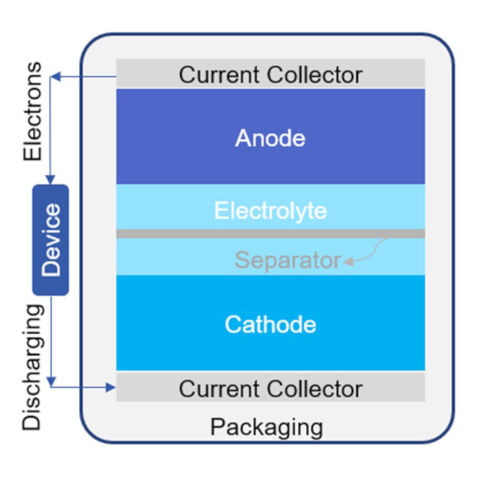
Furthermore, IDTechEx research reveals that silicon anode material can enable significant improvements in specific energy and energy density compared to the most modern lithium-ion cells. Silicon anodes will allow for faster charging and higher power output compared to graphite anode cells. Silicon also increases the battery cell's discharge capacity, thus significantly improving energy delivery at low State of Charge (SOC). The IDTechEx report details the relationships between original equipment manufacturers (OEMs) and suppliers and highlights the battery technologies used by industry leaders.
Land infrastructure to catch up
With the aircraft certification just a few years away—2025/26 for the first ones—infrastructure development has not kept pace with OEMs, who have fallen behind. While most eVTOL aircraft will initially operate outside of existing infrastructure (airports, heliports), as the market develops and grows, these aircraft will utilize their unique performance capabilities to land atop buildings and other suitable spaces in densely populated urban areas.
Currently, the general message from regulatory bodies is that they would like to see safe operations from existing airports and heliports before licensing new vertiports. Studies by IDTechEx have revealed that, in the short term, dual-use landing sites can absorb the movements of traditional helicopters before electric operations begin.
Author: Shazan Siddiqi, Senior Technology Analyst at IDTechEx