However, the different characteristics of various battery types present technical challenges for consumers and even engineers when selecting batteries and chargers. This article will discuss the differences between two of the most popular battery types: lead-acid and lithium batteries, as well as how to select a suitable charger.
Characteristics of Lead-Acid and Lithium Batteries:
Lead-acid batteries, as one of the most popular types, have a long history. Some of their advantages include high charging voltage tolerance, high overcurrent capacity, wide operating temperature range, and low cost. They are often found in mobile applications such as cars and forklifts, as well as in backup power systems. The disadvantages of lead-acid batteries are their high self-discharge rate and relatively short charge/discharge cycles; therefore, they are not suitable for energy storage applications.
Unlike lead-acid, the high charge/discharge rate, low self-discharge rate, and high energy density of lithium batteries make them a better choice for longer-term energy storage. Depending on the metal used in the cathode of lithium batteries, there is a variety with different performance characteristics. Lithium cobalt oxide (LCO) has a high energy density and is ideal for personal electronics. Lithium iron phosphate (LiFePO4) has a longer lifespan and relatively good thermal stability, making it a better choice for energy storage solutions. The limitation of lithium batteries is that thermal runaway can cause them to catch fire. Therefore, lithium batteries require more controlled charging and discharging.
Battery Charging Algorithm:
The nominal voltage of a single lead-acid cell is approximately 1.8–2.3V with a maximum recommended charging current of 0.3C. Most commercially available batteries have many cells connected in series and parallel to form a high-capacity battery at more practical voltages such as 12V, 24V, and 48V. Note that "12V," "24V," or "48V" are often used inaccurately as an indication of the voltage range. The actual voltage will constantly change depending on the remaining capacity. For example, the open-circuit voltage of a typical '12V' AGM lead-acid battery is between 10.8V (30% battery capacity) and 13.8V (100% capacity).
Due to the high self-dissipation rate of lead-acid batteries, a 3-stage charging method is often recommended. A typical charging cycle begins in the constant current stage ("stage 1" in Figure 1), where the charger limits its output current to its maximum capacity and slowly increases its output voltage. Once the battery voltage reaches the maximum charging voltage, the charger switches to the constant voltage stage ("stage 2" in Figure 1). The charger then begins to output its maximum nominal voltage continuously, monitoring its output current. Finally, the charger switches to the float charging stage ("stage 3" in Figure 1) after the charging current drops below approximately 10% of the nominal current. In this stage, the charger reduces its output voltage to prevent overcharging. Although the battery is close to being fully charged at this point, it still draws power continuously from the charger to compensate for self-dissipation. Figure 1.
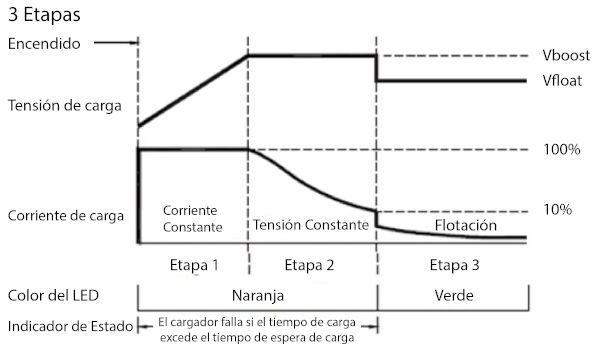 3-stage charging curve.
Lithium batteries can have nominal voltages from 3.2V to 4.4V with a maximum charging current of up to 1C. Even the same chemical variant of lithium batteries, but from different manufacturers, can have different nominal voltage and charging current. Unlike lead-acid batteries, lithium batteries do not tolerate high charging voltages and do not require float charging to maintain their condition. Therefore, lithium batteries are often charged in two stages (Figure 2), without the float stage.
Figure 2. Two-Stage Charging Curve.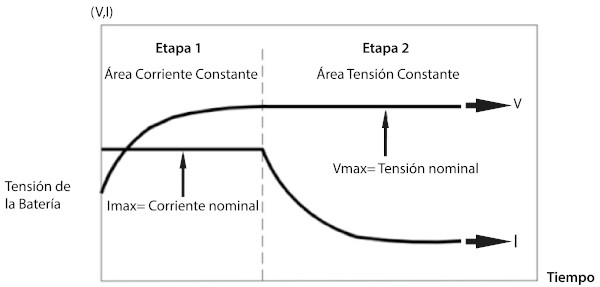
Cell imbalance is a concern for many lithium batteries. Due to manufacturing tolerances, the equivalent series resistance (ESR) of lithium cells cannot be perfectly matched. The difference between them causes cells in the same bank to charge at different voltages or currents. Cells with low ESR will always fully charge/discharge first, so those cells will age and fail faster. Cell imbalance not only shortens battery life but could also lead to thermal runaway and become a safety hazard. To solve this problem, large lithium battery banks should always be equipped with battery management systems (BMS). The basic function of a BMS is to monitor the state of charge and balance the cells passively or actively. A passive BMS balances the cells by discharging the fullest cells using power resistors. It is robust and relatively easy to design, but less efficient and less effective. On the other hand, the active BMS charges the cells individually to match their charge levels. Because the active BMS has charge control for each cell, some lithium battery banks with an active balance BMS only require constant voltage AC/DC power supplies as a charger.
MEAN WELL Intelligent Battery Charging Solution
As mentioned earlier, batteries of different chemistries and from different manufacturers can have different characteristics. It is also recommended (mandatory for lithium batteries) to have an optimized charging curve to ensure reliability, longevity, and safety. MEAN WELL programmable DC chargers, with the SBP-001 intelligent charge programmer, offer flexibility and a user-friendly interface for adjusting the charging curve.
As an example, we will use the new HEP-1000 series and choose the HEP-1000-48 model with a constant voltage of 48V and a maximum power of 1008W. Users can connect the HEP-1000-48 to the MEAN WELL SBP-001 intelligent charger programmer and enable charger mode. The default charging curve is 3 stages (Figure 3) for typical sealed lead-acid batteries with a boost charge voltage of 57.6V and a float charge voltage of 55.2V. The charging voltage and current can be easily adjusted to 36–60V and 3.5–17.5A respectively for other types of lead-acid batteries.
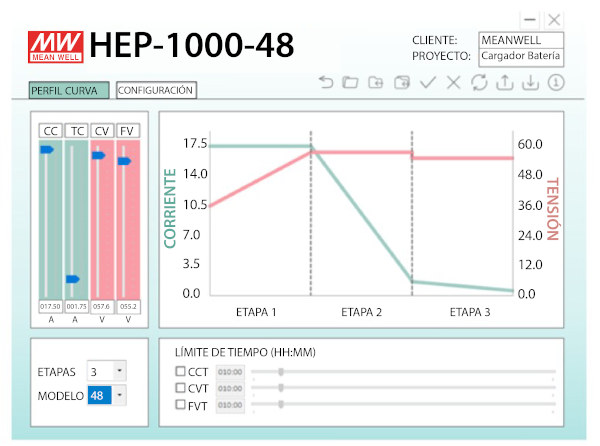 Figure 3 shows the intelligent charging program (HEP-1000-48, 3-stage charging).
By simply selecting the 2-stage charging mode, the HEP-1000 can also be used to charge lithium batteries within the same adjustment range. To charge a 20Ah LiFePO4 battery with a maximum charging voltage of 56V, the "CV" and "CC" options, shown in Figure 4, can be set to 56V and 17.5A for faster charging. The user can also reduce the charging current to prevent overheating and low voltage drops, thus avoiding the possibility of overcharging.
Figure 4. Intelligent charging program (HEP-1000-48, 2-stage charging)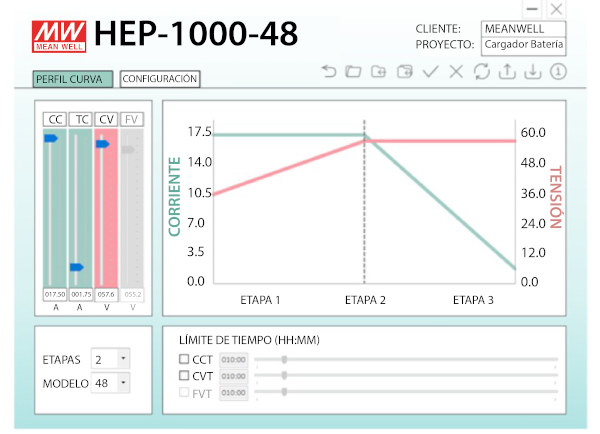
conclusion
, MEAN WELL's programmable chargers can be used to customize the charging curves required by lead-acid or lithium batteries. Adjusting the charging voltage and current based on temperature preserves the battery, optimizes its capacity, and extends its lifespan.
Author: Anke Ge/Technical Service Center
Translation: OLFER Electronics Marketing Department