Autonomous offshore power systems (AOPS) capture the mechanical energy of waves and convert it into usable electricity for a wide variety of applications in the ocean, such as offshore oil and gas exploration and production, offshore carbon dioxide extraction, oceanographic research, aquaculture, and defense.
 Ocean energy capture on the order of kilowatts
C-Power has specialized in the burgeoning field of ocean energy harvesting (Figure 1). While other companies develop large, megawatt-scale systems, C-Power focuses on remote, kilowatt-scale systems for offshore data communication networks, initially through a DARPA project called WEBS (Wave Energy Buoy Systems).
The WEBS project enabled C-Power to discover an emerging opportunity in the localized generation of electricity for underwater vehicles, submersible equipment, and sensors deployed in the open sea used to collect environmental data. Previously, electricity for these applications was generated using expensive, bulky, and non-rechargeable batteries installed on board or powered via an underwater cable from a ship or diesel generator. The development of AOPS allowed C-Power to open the door to entirely new applications with an autonomous, environmentally friendly, ocean-based power source that can also function as a communications channel.
The new AOPS platform, called SeaRAY, is central to C-Power's short-term strategy, which focuses on producing wave energy systems that generate 10W to 1MW. To achieve its goals at lower power levels, C-Power created a SeaRAY AOPS design with a high power-to-weight ratio, utilizing power conversion technology from Vicor Corporation. Its small size improves mobility and commercial viability, facilitating the delivery and installation of SeaRAY and saving tens of thousands of dollars in operating costs.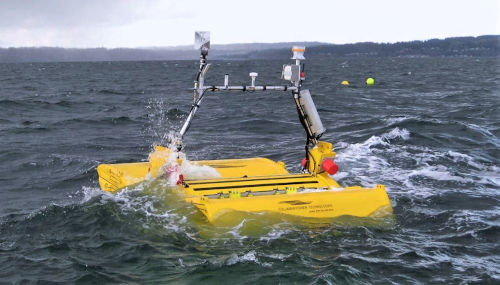
SeaRAY's design also enables remote and autonomous communications by transmitting real-time data from the ocean to the cloud. Previously, marine systems have been limited in the volume and frequency of data collection. Using cellular networks and satellite communications to send real-time data between the cloud and SeaRAY allows for the collection and delivery of more data more frequently (Figure 2).
Energy capture from a continuously varying source
The biggest design challenge for C-Power was reconciling the complex properties of wave energy with SeaRAY's demanding power conversion requirements. These requirements included a very wide input range of 30:1, reflecting the unpredictable nature of the waves. The Vicor Power Systems design team delivered a system capable of converting power with high efficiency and charging the energy storage devices. The solution also accepts external control signals from C-Power to precisely meet real-time conversion needs.
 Figure 3. SeaRAY uses Vicor BCM® fixed ratio bus converters and PRM™ regulator modules with discrete multi-phase converters to convert wave energy and provide controlled power.
SeaRAY converts wave energy pulses into a variable DC bus while producing a constant current for various power levels. The power conversion topologies used in the modules help minimize electromagnetic interference and noise from SeaRAY, which could otherwise affect the accuracy of the sensor's measurements.