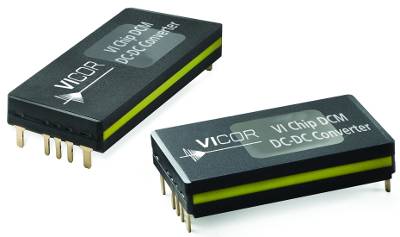
 This series now covers critical applications within the aerospace, electric and hybrid vehicle, harsh environment, industrial, and telecommunications/data communications sectors. The DCMs offer nominal input voltages of 24, 28, 48, 270, 290, and 300 V, nominal output voltages of 48, 36, 28, 24, 15, 12, and 5 V, and are available in packages with power ratings up to 600 W.
DCMs can be combined with Vicor FPATM components and/or ZVS regulators, enabling complete power solutions that provide dense, efficient, and scalable power between source and load. Designers can connect DCMs downstream of regulators at the point of load in Vicor's ChiP and SiP (system-in-package) solutions, creating a complete, integrated power solution that delivers dense, efficient, and scalable power between source and load. This combination of differentiated products, reflecting Vicor's Power Component Design Methodology, provides unsurpassed levels of performance, ease of use, and total cost of ownership.
By utilizing Vicor's DC-ZVS topology within the DCM series, a typical efficiency of 93% can be achieved, along with a power density more than twice that of conventional DC/DC converters. With a power density of up to 1244 W/in³, DCMs allow engineers to optimize the size, volume, and weight of end systems. Furthermore, up to eight DCMs can be connected in parallel without performance loss and without requiring additional circuitry. When configured in this way, a DC/DC solution of up to 4.8 kW can be obtained.
Vicor DCMs are supplied in two insertion packages: a CHiP 4623 package (46 x 23 mm) capable of reaching 600 W of power and a CHiP 3623 package (36 x 23 mm) that reaches up to 320 W.
About Vicor's Converter-in-Package (ChiP) Platform:
The ChiP platform sets new standards for a new range of scalable converters.
Leveraging advanced magnetic structures integrated within the HDI (High Density Interconnect) substrate with power semiconductors and control ASICs, the ChiPs provide superior thermal management, resulting in unprecedented power density. These thermally advanced ChiPs enable customers to design low-cost power solutions with previously unattainable system size, weight, and efficiency specifications quickly and predictably. The advent of ChiPs opens the door to a new modular power system design methodology, allowing designers to achieve high-performance, cost-effective power systems—from AC or DC input sources to the point of load—using proven building blocks.