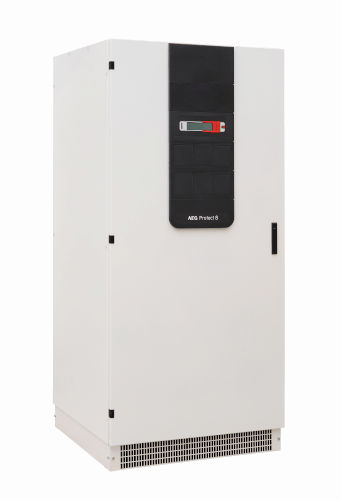
The classification of UPS systems by their output power indicates nothing about their capacity, that is, the period of time for which they are designed to provide power. A UPS may be configured to replace the mains power supply for an extended period, up to several hours, or it may be used to provide "bridging" power, meaning it offers instantaneous power after a loss, but only for a few seconds or minutes until a source such as a diesel generator can start and provide a stable output. There is also a short-term usage model in which the UPS does not need to operate continuously but only provides enough power to ensure an orderly shutdown of the customer's system.
 Batteries Power Most UPS Systems.
Although other technologies, such as flywheels, can be used, most UPS systems use batteries to store energy. Batteries provide high capacity and are capable of delivering power almost instantaneously. For a UPS to operate reliably, it is essential that the batteries are not only fully charged but also in good condition.
Despite numerous advances in battery technology in other areas, the cells used in UPS applications still employ one of the oldest chemistries: lead-acid. Lead-acid cells have been phased out of standby power applications for several reasons. They offer good energy density (though not exceptional for current demands) in terms of charge stored per unit volume; they have very good power density, as they deliver high currents without causing damage; their high pitch, which makes them unsuitable for many portable applications, has little impact on UPS installation; and perhaps most importantly, they are inexpensive. Another factor to consider, given current environmental awareness, is that they are relatively "ecological": almost all of their components, but especially lead, are completely recyclable.
The charging characteristics and duty cycle of lead-acid cells are also well-suited for UPS applications. VRLA (valve-regulated lead-acid) cells not only tolerate constant float charging, but their operational life is maximized by maintaining a full charge and rarely deep-discharging them. However, batteries have a finite lifespan, which can be significantly shortened if environmental conditions—especially temperature—fall outside the optimal range. In most installations, cells are replaced at fixed intervals according to the warranty, which is typically five years. This approach is flawed: batteries operating outside the expected environmental conditions may fail sooner, while properly maintained batteries can have a longer operational life.
 Fault Tolerance:
Modern UPS systems are required to deliver high power levels, hence the need for many cells. In long strings, a failure in a single cell can cause the entire string to fail. Large and medium-sized UPS systems implement redundancy to ensure that a failure in a single string does not result in the entire UPS failing. While the UPS will continue to operate, the peak current it can supply and the system's runtime using the UPS will be reduced. Furthermore, a failed cell can damage other blocks in the string, thus reducing its operational life.
Battery monitoring and maintenance represent a significant cost associated with UPS operation. Typically, an engineer visits the facility periodically—perhaps monthly—to measure the electrical characteristics of the cells in the system. The standard practice involves measuring cell voltages to identify cells operating outside of range, which will then be replaced. Output voltage is not always reliable in predicting failure. While a cell exhibiting a terminal voltage significantly below its nominal value is immediately identified as a potential failure, lead-acid cells can display a satisfactory terminal voltage even if their capacity has been reduced or they are in the early stages of failure. Therefore, cells can fail between these scheduled maintenance cycles and require the additional engineer visit.
Continuous monitoring reduces costs.
Continuous battery monitoring not only reduces costs by minimizing the time an engineer spends physically checking each battery, thus making their visit more efficient, but it also enables preventative maintenance. By identifying potential faults, cells can be replaced during routine visits, ensuring superior reliability and eliminating the need for emergency engineer visits.
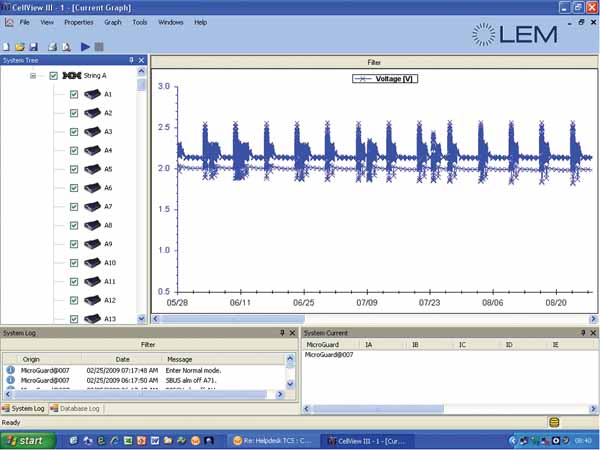
Figure 1 shows the results of a comprehensive monitoring exercise that measured the cells in a broadcast facility with an 800kVA UPS. The graph indicates the output voltages of various cells in one of the strings. In this case, each string had 200 monoblocks (a monoblock is what in other contexts might be called a battery: multiple cells in a single casing) providing approximately 440V. There is considerable voltage variation due to incorrect battery conditioning settings; this will be discussed later in this article.
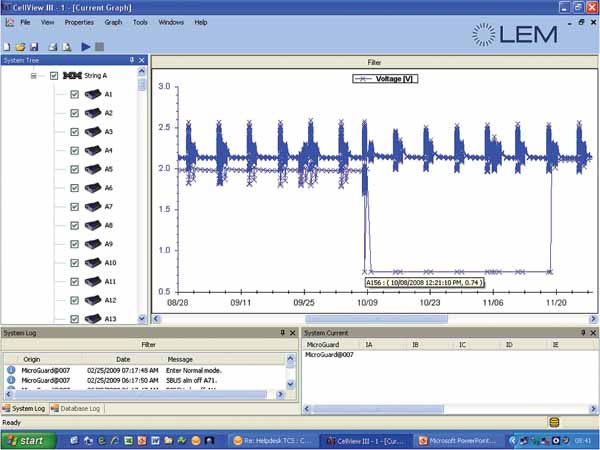
 The graph clearly indicates that one cell is supplying 2V, instead of the nominal 2.2V. Although the block is producing a lower voltage than expected, the difference is relatively small, within acceptable limits, and stable. This behavior is common, so using the output voltage as a fault indicator is unreliable, as voltages can remain within limits and therefore not trigger alarms. This is what happened in this example; at the time this data was collected, the monitoring system was being used to verify the effectiveness of the scheduled maintenance strategy, not to detect potential problems. Since no action was taken, the cell subsequently failed catastrophically during the period covered by the graph in Figure 2; the horizontal axis indicates the dates on which the tests were carried out. However, before the point of failure, at which the cell voltage dropped to 0.7V, the voltage of the failed block remained essentially constant, giving no warning of the impending failure. Finally, in November, the maintenance staff replaced the monoblock and the corresponding voltage levels returned to levels indistinguishable from the average for the entire set of cells.
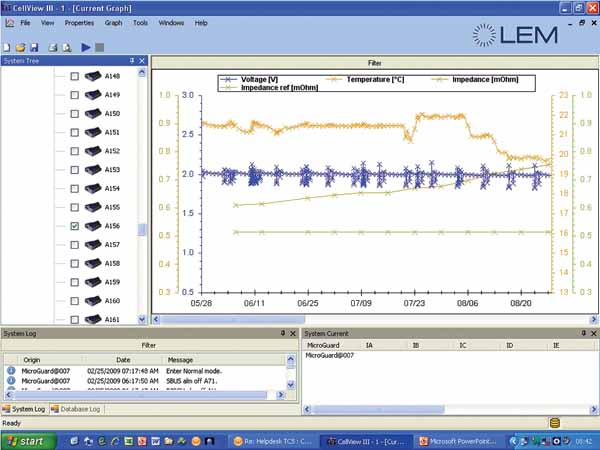
This confirms that output voltage is not a reliable predictor of failure: a different parameter – impedance – is a much better indicator, as shown in Figure 3. This graph illustrates the increase in impedance in June, and by the beginning of July, the value had increased by more than 20%. A trend is easily discernible: measuring the impedance could have identified the problem three months before the cell failed. Using this data, the cell could have been replaced during routine preventative maintenance before the deterioration that led to the failure.
Impedance Measurement in Operation:
Voltage measurement is straightforward with the cells in operation; however, with advanced monitoring techniques, impedance can also be accurately determined non-intrusively. These figures show the output of a monitoring system that performs periodic measurements by superimposing a calibrated waveform with specific frequency characteristics above the float charge voltage. Measuring the voltage and current at these frequencies reveals the basic performance of the batteries. The test waveform has been developed to reveal any underlying changes in cell performance; however, since assessing only the measured voltage provides little warning until failure occurs.
 Continuous monitoring also provides useful information that can help increase UPS reliability. For example, in Figure 1, it is clear that there are numerous charge/discharge cycles (indicated by the peaks in the voltage curve). Although the batteries require conditioning, this battery discharge pattern is too frequent, with 4-5 discharges per month. While some battery conditioning extends operating life, too many discharge cycles reduce it: a normal configuration will cycle two or three times per year. Cells typically have a guaranteed lifespan of 20-50 cycles. In the case under examination, the batteries would exceed this in just a few months, and a battery replacement strategy every five years would mean that the cells would be subjected to many more discharge cycles than they were designed for.
The frequent charge/discharge cycles in this installation were due to the installer leaving the UPS in commissioning mode, so the battery was frequently charged to allow for testing. This is a surprisingly common error that can drastically shorten battery life. Incorrect configurations won't be apparent to engineers during site visits, but continuous, automated monitoring will reveal the problem.
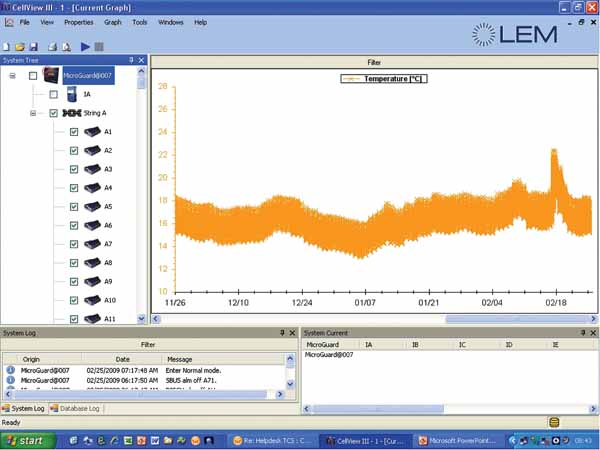
Another factor that reduces battery life is high temperature. Even a small increase in temperature increases the number of unwanted chemical reactions in the battery, which will ultimately lead to its failure. Battery manufacturers typically specify battery lifespans at 20°C. Figure 4 shows the variation in ambient temperature in this system over time, reaching 22°C at one point. The air conditioning failed to maintain the temperature within an acceptable range, resulting in a decrease in battery life. Furthermore, the higher temperature could void the battery manufacturer's warranty.
We have seen that continuous battery monitoring offers numerous advantages, beyond simply reducing costs by making engineer visits to the site more efficient. In this example, automatic battery impedance monitoring would have identified a cell failure three months before the final breakdown.
Continuous monitoring also simplifies the identification of UPS configuration problems: an incorrect charge/discharge rate can drastically shorten battery life. Monitoring measures environmental conditions, ensuring that operating life is not reduced by high temperatures.
Monitoring maximizes cell life, reduces the risk of failure, and saves money by ensuring that circuits do not need to be replaced prematurely and by enabling the early detection of deteriorating cells, often allowing for their replacement before the circuit fails. Although critical systems like UPSs are not a primary target for cost reduction, it is important for users to adopt continuous monitoring because it lowers costs and increases reliability.
Author: Loic Moreau, LEM SA