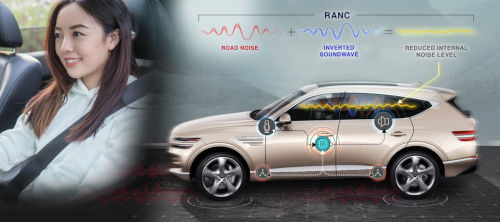
So, active noise cancellation (ANC) technology, used in high-end audio noise-canceling headphones, was adopted and implemented in millions of vehicles. While ANC is effective at canceling narrowband engine noise, it has little effect on suppressing broadband noise generated by the tires (road noise).
A joint technology workshop with industry leaders Analog Devices, Inc. (ADI) and Hyundai Motors (HKMC) addressed road noise cancellation. ADI is a full-solution technology company known for solving the toughest engineering challenges. Hyundai Motors, a pioneer in the automotive industry, wanted to differentiate its brand and develop technology that would dramatically reduce noise in its vehicles.
The two teams collaborated to implement the industry's first fully digital active rolling noise control (RANC) system. The challenge was to implement RANC in a practical and easily manufacturable way. In early 2020, the innovative RANC system was accelerated into mass production and incorporated into Hyundai's flagship GV80 cars.
And that's just the beginning. Hyundai envisions building a path to the future, going far beyond noise cancellation technology to deliver a more immersive, entertaining, and high-quality sound experience for both drivers and passengers across its entire fleet of vehicles.
Case description
objective
is to offer human-centered and environmentally friendly technologies and services that lay the foundation for a more comfortable, convenient, and safe driving experience.
Challenge:
To introduce the industry's first fully digital road noise cancellation system to the market, make it affordable, less complex and lighter, and accelerate its implementation in mass production.
Application:
Take advantage of ADI's Automotive Audio Bus (A2B®) technology for your essential audio connectivity and infotainment application capabilities.
Objective:
To develop audio and infotainment connectivity applications across the entire vehicle fleet. To create a more dynamic automotive experience.
Reduce noise
In the past, automakers who wanted to reduce cabin noise and make their vehicles seem more luxurious added soundproofing barriers—on the floor, hoods—wherever they could. Even with the advent of lightweight materials, they could only add so much damping before the extra weight affected fuel efficiency. So they turned to a simple analog technology: active noise cancellation (ANC), first used in the 1950s to reduce the deafening roar of engines in helicopter and airplane cabins, and later popularized by the headphone industry.
ANC is a simple and elegant solution for canceling narrowband noise rather than dampening it. Like a ripple on a lake that combines with a depression, ANC works to flatten or cancel a sound wave.
Eliminating road noise isn't so much about silence as it is about eliminating the fatigue that noise creates for the driver and passengers.
 How does active noise cancellation work?
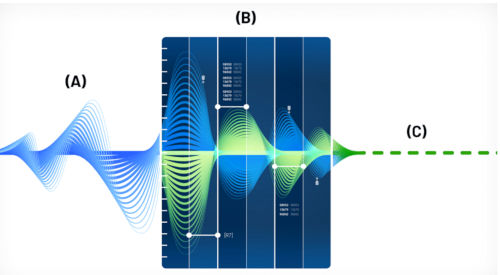
ANC technology works on the same principle as noise-canceling headphones, using software and components such as DSPs and microphones to measure and reduce noise. Microphones in the vehicle's cabin pick up engine noise and transmit it to the digital signal processor (DSP), where the ANC algorithm processes it and sends an inverted audio signal through the speakers. Known as destructive interference, the generated sound is imperceptible to the driver and passengers but sufficient to cancel out the engine noise.
The ANC application "listens" for the unwanted external engine noise and then (A) plays back a sound that is 180 degrees out of phase (B), so that the noise is "canceled out" (C) by the time it reaches the ear. To achieve this, the digital processing must be very fast.
ANC Limits
ANC technology is only effective when the noise is constant, predictable, and low-frequency, such as the narrowband rumble of an engine.* Random, broadband noises, such as potholes, are filtered out because the ANC signal and processing speed cannot react quickly enough to generate a counter-wave. Its software and hardware struggle to process the cancellation in the 4 ms (4 milliseconds) it takes for road noise to reach the passenger's ears. Hyundai was looking for a better solution for its vehicles.
*This disadvantage can sometimes act as an advantage. When driving, it's essential to hear critical sounds: a car horn or the siren of a fire truck or ambulance. Since ANC only cancels low-pitched, continuous sounds, these critical, higher-pitched, and irregular acoustic signals are heard loud and clear.
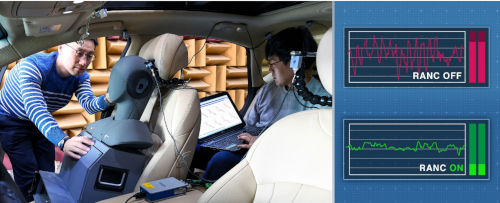 Hyundai technical team conducting measurements in RANC tests.
Hyundai and Analog Devices, Inc. (ADI) have maintained a long-standing relationship for over a decade. Starting in 2012, ADI provided Hyundai with digital signal processing (DSP) technology for its premium audio amplifiers. In the following years, the relationship quickly evolved to focus on Hyundai's Road Noise Active Control (RANC).
RANC
's latency and signal processing are not only fast, but more than four times faster than the speed of noise traveling from the road to the cabin. In just 2 ms (2 milliseconds), RANC analyzes road noise and sends an inverted sound wave through the car's stereo speakers, flattening the noise before anyone inside the cabin can hear it. In testing, RANC reduced cabin noise by half, or 3 dB (three decibels).
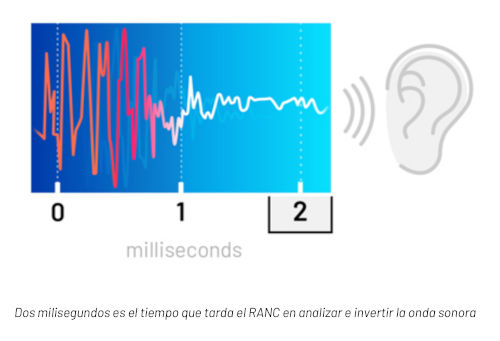 Two milliseconds is the time it takes the RANC to analyze and invert the sound wave
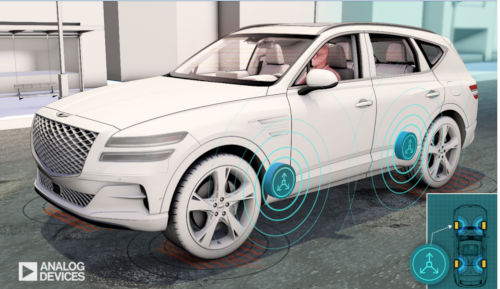 The RANC system proposed by Hyundai consisted of four main components:
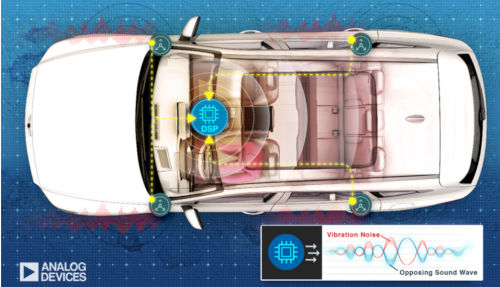 Accelerometer
: Accelerometers, located near each tire, detect vibrations from the tires and suspension.
 Processor:
The Adaptive Driver's (ADS) proprietary algorithm counteracts vibration noise in milliseconds with an equal and opposite sound wave transmitted through the speakers.
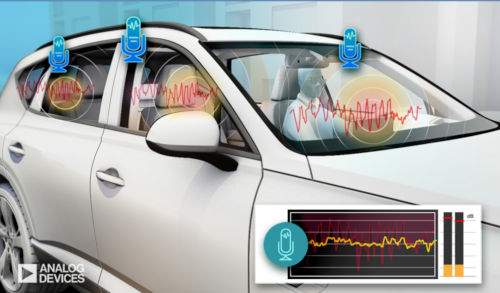
Microphones:
Simultaneously, microphones measure the sound in the cabin and ensure that an accurate noise reduction signal is generated.
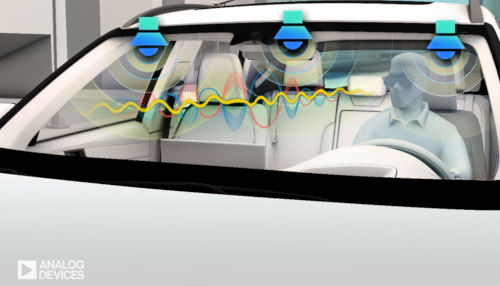 Speakers:
The cabin speakers complete the signal loop and reduce the sound wave. The result is a quieter interior zone around each passenger and an audibly more comfortable driving experience.
In early 2015, Dr. Kang-Duck Ih, a researcher at Hyundai's NVH Research Lab, and his team were conducting R&D on algorithms for their RANC applications. ADI engaged Dr. Ih and the team members to introduce a new family of Griffin DSPs (digital signal processors) to implement the RANC algorithm. When discussing RANC architecture, ADI learned that Hyundai's solution, based on traditional analog connectivity, was prohibitively expensive and impractical. The deployment of road noise cancellation systems in the automotive industry has been hampered by the lack of a cost-effective, low-latency network technology that efficiently connects the necessary input sensors to the DSP.
The A2B solution
A2B was introduced as a cost-effective, low-latency, unshielded twisted-pair connectivity solution to replace expensive, bulky point-to-point coaxial cables. In addition to supporting up to 32 channels of audio, control, and phantom power over the same cable, A2B also enabled optimized daisy-chain network topology, further reducing the weight and complexity of the wiring harness.
Vlad Bulavsky, General Manager of In-Car Connectivity at Analog Devices Inc., stated, “We initially approached the Hyundai team to present the ADI DSP and A2B technologies and roadmaps. Hyundai’s challenge was the practical implementation of their RANC system. As a result of multiple brainstorming sessions, we were able to arrive at a practical and deployable RANC solution using ADI A2B, accelerometers, and Griffin DSP to replace a competitor’s processor for Hyundai’s next-generation vehicles.”
Hyundai and ADI met continuously from 2015 to 2016 to collaborate on the solution. The two teams successfully deployed the industry's first fully digital road noise cancellation technology in Hyundai's GV80 in early 2020.
 Hyundai GV80 - Image courtesy of Hyundai
A2B Advantage: Greener vehicles. Superior features. Better designs
A2B connects multiple remote sensors for different applications in a daisy-chain sequence, significantly reducing redundant wiring runs. As a result, the weight of the cable bundle decreases dramatically, while overall design costs and complexity (design, installation, and maintenance) are reduced due to the fewer cables.
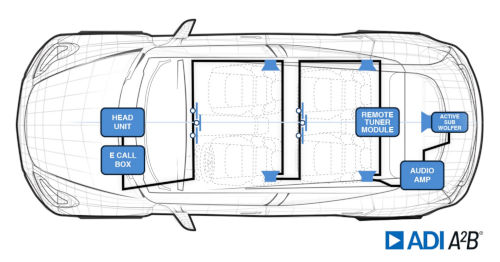 “We’ve worked closely with Hyundai to design their fully digital RANC system, which leverages our A2B technology to reduce equipment costs, weight, and design complexity, while also improving overall fuel efficiency and helping to address several challenges of the electronic RANC system,” said Andy McLean, Vice President of In-Car Experience at Analog Devices. “ADI’s work with Hyundai demonstrates the growing viability of A2B and further distinguishes Hyundai vehicles in today’s market.”.
“RANC is a great example of an application where different technologies are needed to form an efficient system solution,” says Vlad Bulavsky. “ADI’s DSP, A2B connectivity, accelerometers, and software IP combine seamlessly to deliver a cost-effective, high-performance solution to a very challenging acoustic problem.”
The future is very promising for RANC and ADI's DSP, A2B, and accelerometer technologies applied to electric vehicles (EVs). In electric propulsion systems, there is no engine noise, so road noise is more noticeable. Robust noise cancellation technology is still being developed
Better Sound Systems: A car is more than just a means of getting from point A to point B. It's a reflection of personal lifestyle. Consumers spend more time listening to music in their cars than anywhere else. Taking advantage of its new quiet cabin, Hyundai has developed stage-quality sound, expertly tuned for the road, with its premium Lexicon® Audio System with Quantum Logic® Surround. Combining 1,050 watts of amplified power with 21 speakers and subwoofers strategically placed at 17 points throughout the cabin, the GV80 creates a surround sound experience perfectly tailored to each passenger. While commutes in the future may still be long, drivers and passengers can relax in a safer, quieter, and more entertaining personalized space as a result of the collaboration between ADI and Hyundai.
RANC and time to market
For over 20 years, audio system manufacturers have made headlines for the successful development and implementation of RANC, but never for its mass production.
How did Hyundai Motors and ADI develop a solution to bring the product to market with scalable production? A key factor in the program's success is the speed and urgency with which Hyundai Motors and ADI developed the RANC technology. Their deep collaboration helped create synergies spanning vehicle design, assembly, production, and after-sales service, enabling a rapid time to market.