The tools for these microcontrollers have also improved over the years, and designers now have a set of excellent compilers and function libraries, which greatly enhances the software development process. In modern systems, additional functionalities are also implemented, expanding the range of applications in which microcontrollers can be used.
A significant factor contributing to the continued development of "simpler" 8- and 16-bit microcontrollers is the Internet of Things (IoT) application market. Due to the large number of devices and applications operating in this segment, systems face the requirement of low power consumption. This applies particularly to smart sensors with wireless connectivity, wearables, information systems that replace traditional price tags in stores, beacons, and so on. Very often, such devices are battery-powered, and users require maximum operating time without needing to replace the battery. In these applications, 8- and 16-bit microcontrollers are unrivaled, as they can easily be put (and quickly activated) into a low-power mode, in which their peripherals and/or core are in power-saving mode and are activated/awakened only for the time required to perform the necessary actions.
Modern microcontrollers utilize peripheral modules that can operate independently of the CPU and perform specific tasks (traditionally handled by the CPU in software) independently and in hardware. This results in low power consumption and frees up the computing power of a relatively small microcontroller, whose core can then be used for application-critical tasks. Using these modules shortens the development time for new applications. Furthermore, these peripheral modules, of various types, implemented in microcontrollers can be combined internally into larger blocks, enabling the implementation of more complex functions. To facilitate the configuration of core-independent peripherals (CIPs) for designers, manufacturers provide tools with a user-friendly graphical interface.
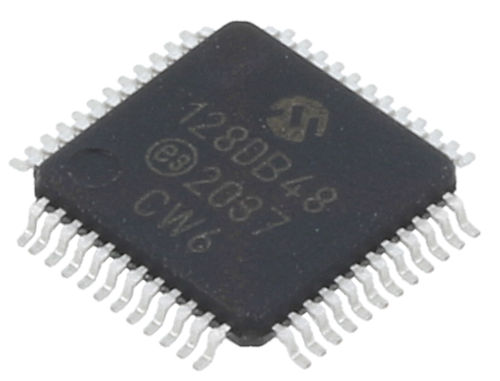
 AVR128DB Family Microcontroller in TQFP48 Package.
Microcontrollers with the aforementioned characteristics were a must-have in Microchip's product line.
AVR128DB
family of microcontrollers combines the performance of a low-power AVR® core with a set of Core Independent Peripherals (CIPs) and a large number of integrated analog peripherals. The ability to operate with a 5V supply voltage increases interference immunity.
Below, we will primarily analyze the CIP peripherals available in the AVR128DB series, although the functionality of the systems themselves is much broader. The AVR128DB family of microcontrollers includes, among other features, 10-bit analog-to-digital converters (ADCs), a real-time clock (RTC), PWM generators (including 12-bit TCB generators adapted for power systems), hardware USART, SPI and TWI interfaces, reference voltage sources for precise measurements, comparators, and the ability to generate external interrupts on all I/O pins. AVR128DB circuits are also equipped with up to three built-in operational amplifiers. Combined with the analog-to-digital converters, these enable comprehensive and accurate processing of input signals. The microcontrollers also have an input/output port adapted to work with various logic levels (from 1.8V to 5.5V), making the use of external converters unnecessary. This is the next step towards miniaturization and energy efficiency of circuits, and the systems used will be manufactured by Microchip. We recommend that you familiarize yourself with the complete product range.
Event
System is a powerful microcontroller kernel offloader. It allows you to establish simple dependencies between events. Conditional statements will execute without the kernel (or even without waking it up). One example is the operation of a button, independent of program code. Exceeding the potential difference set on the comparator can result, for example, in activating the transducer on a specific pin, starting a count, etc. This functionality reduces the amount of code required for the device to operate and increases the overall response speed of the microcontroller.
 Configurable Logic
Cells (CLCs) offer a similar function, also active in low-power mode. They allow you to perform logic operations on signals from external and internal sources (counters, registers) and transfer the result to one of the peripherals or output pins. This eliminates the need for conditional statements in your program code. The CLC module performs the functions of logic gates (AND, OR, XOR, NOT, and their combinations), latches, or flip-flops without the power-consuming activation procedure.
Zero Cross Detector (
ZCD): The ZCD module is used to trigger interrupts when the AC signal exceeds the threshold at zero potential (relative to the microcontroller's GND). The system integrated into the microcontroller can sample the voltage directly from the power line; the only passive component required in this case is a series resistor to limit the current and (optionally) a pull-up resistor. An equivalent analog circuit would require many more components. The ZCD functionality enables effective triac control (light dimming, heating regulation), power quality monitoring (period measurement), or EMI disturbance limitation in circuits that control the power supply of a given AC device (turning on when the sine wave is near zero, eliminating voltage spikes and the electromagnetic disturbances they generate). Furthermore, the peripheral can be configured to signal a specific type of overshoot (rising curve, falling curve, or both). The ZCD signal does not need to be programmed and can be sent to one of the microcontroller's I/O pins.
Advanced Watchdog Timer:
Even the best-designed digital circuits that operate flawlessly and have repeatedly reviewed code can "lock up." This problem can occur for many reasons, sometimes unrelated to the functions performed by the code. It could be due to exceeding the permissible operating temperature or a disturbance on the power line. The basic protection against such situations is provided by watchdog timers (WDTs), which operate independently of the running program. If an instruction takes longer than expected to execute, the WDT resets the microcontroller. In the case of the AVR128DB family, it is possible to program a "time zone" (Window Mode Watchdog Timer, WWDT) within which the program will run. In the event of such a check, the device's operation will be interrupted and restarted from the beginning, whether the period between core responses is too long or too short. In the latter case, it is possible that part of the instruction was not executed with negative consequences, especially if the omitted operation block was directly related to the protection of the circuit or device operator (e.g., an unnoticed limit switch signal).
Cyclic Redundancy Check (CRC/SCAN)
Generating and verifying a checksum is a commonly used method to ensure efficient communication between systems in microprocessor systems. Unfortunately, implementing such a checksum in software consumes significant processing power and can slow down the operation of the systems involved, especially with 8-bit units running at a limited frequency (to conserve power). The latest Microchip microcontrollers (both PIC and AVR) are equipped with peripherals that automatically generate a checksum (even in the form of a 32-bit polynomial) and place it in a program-accessible register. The functionality known as SCAN allows the CRC system to directly access the microcontroller's memory, further improving the handling of checksums.
Examples of using CIP modules in specific applications and the benefits of using them when creating circuits that implement complex functionalities are shown in the videos prepared by the manufacturer below.
Content prepared by Transfer Multisort Elektronik Sp. z oo.
The original source of text