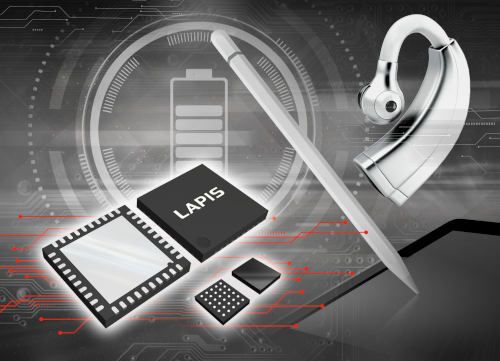
 This makes it ideal for wearable devices with large battery capacities designed for extended wear. Typical products include wrist blood pressure monitors, fitness trackers, smartwatches, and hearing aids. Furthermore, the adoption of the 13.56 MHz high-frequency band enables compatibility with near-field communication (NFC).
Providing wireless power and communication in a single chipset helps improve design flexibility in devices with rotating mechanisms, which would normally be restricted by wired designs, such as industrial equipment, PC fans, and torque sensors on electric bicycles.
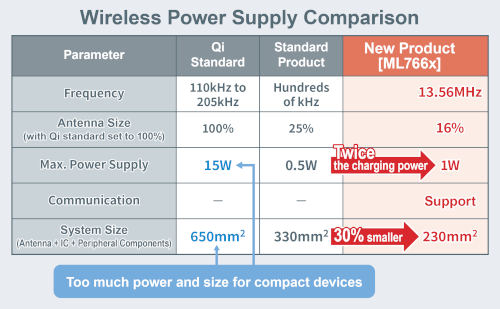
In recent years, the need to improve the safety of compact electronic devices (especially small medical devices) against electrical shocks has increased. Wireless power supplies eliminate the need for a power cable, significantly improving safety during charging or in cases of perspiration by enhancing the water, dust, and shock resistance of sealed enclosures. However, while the Qi standard is widespread and can deliver up to 15W, the system size, including the chipset and antenna, is also typically large, making it difficult to incorporate into wearable devices.
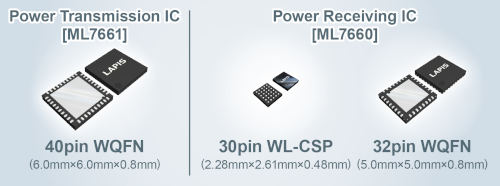
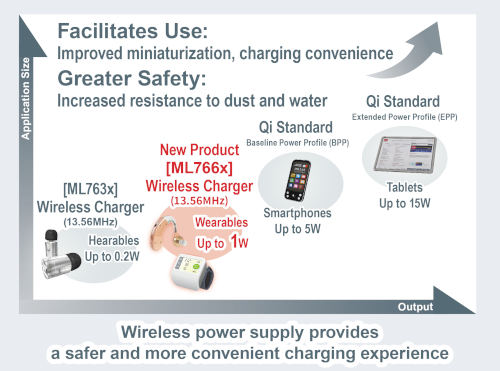 In response, ROHM Group's LAPIS Technology previously developed the ML763x chipset, which uses the 13.56 MHz frequency band to deliver 200 mW of power and enable wireless communication. However, despite its positive market reception, there were calls for greater power output for wearable devices with large-capacity batteries, such as wrist blood pressure monitors, smartwatches, and hearing aids. ROHM's latest chipset addresses this need by providing up to 1 W of power in a compact form factor, thus expanding the range of applications.
Development Support
: An evaluation kit is available to facilitate immediate evaluation of this new 13.56 MHz wireless power supply chipset. ROHM supports the configuration of charging systems to meet diverse customer requirements. For example, tools are available for individual user configuration via PC, along with documentation related to antenna design and tuning.
Learn more
Product specifications
Applications
Wearable medical devices up to class 2: hearing aids, wrist blood pressure monitors.
Wearable devices: smart glasses/watches.
Rotating equipment: fans, torque sensors on electric bicycles.
Availability: September 2021 (samples), April 2022 (mass production)