To ensure factory profitability, it's essential to optimize performance and uptime by implementing connected automation and predictive maintenance solutions, which translate into significant value for users. 24/7/365 operation in industrial and logistics environments increases the demands placed on devices, especially systems with active drives and motors, and the failure of a single motor can halt operations or production. New IT solutions for automation, such as edge-integrated artificial intelligence (AI) engines, can identify these irregularities and predict failures in advance, allowing operators to proactively acquire necessary parts, schedule maintenance, and ultimately increase overall operational efficiency.
Automation solutions are becoming increasingly sophisticated, requiring support from leading silicon vendors for both hardware and software. A flexible hardware architecture, at the lowest level, is paramount to keeping pace with innovation in industrial and logistics automation solutions. Software development currently accounts for the majority of costs and labor in industrial project development, thus increasing the value of the libraries, toolkits, and ecosystem support offered by automation technology providers.
FPGAs adapt to the demands of automation.
FPGAs with integrated processors combine flexibility, performance, and programmability to facilitate the rapid adoption and deployment of new technologies and meet the evolving needs of industrial automation. Specifically, FPGAs offer unique flexibility for a wide variety of dynamic automation computing profiles and requirements. Today's FPGAs are characterized by very low power consumption and energy efficiency, enabling their design in smaller form factors with simpler cooling—a critical aspect at the network edge. FPGAs are also fully customizable, providing numerous advantages over software-based solutions, such as lower latency. Furthermore, FPGAs can be used in high-performance control loops, PWM, and with a greater number of connected control motors per unit than comparable high-end microcontrollers. Lattice Semiconductor supplies FPGAs with extremely low software error rates for enhanced reliability, which is ideal for applications demanding high availability and functional safety.
Silicon Can Protect Against Cyberattacks.
Hardware security is crucial for protection against increasingly frequent cyberattacks. Traditional automation installed in factories and logistics was often isolated from the internet and the cloud, even between subsystems. Now, automation systems are becoming increasingly connected, so they must be protected against hackers who can disable systems, blackmail operators, steal sensitive data, or engage in other malicious behavior, or generate enormous financial risks. Microcontroller-based and/or software-based solutions are unable to provide the same real-time protection as alternatives like FPGAs with instant detection, high-performance coverage of multiple subsystems, and the ability to revert to a known good state to recover from attacks—which is paramount. FPGAs can be highly secure and resilient with monitoring at the lowest level (below the operating system), thus protecting the firmware before, during, and after boot, protecting and validating the code itself, and providing a root of trust.
 Optimized Libraries for Automation:
A flexible hardware base supported by equally powerful software from semiconductor vendors and their ecosystem is essential, especially for automation solutions. Software development already accounts for the vast majority of development costs in industrial automation and control projects, making high-quality support crucial for project success. Lattice Semiconductor, for example, provides a lightweight protocol base platform for real-time sensing and control over Ethernet for network connectivity (e.g., enabling multi-axis motor control via Industrial Ethernet and connected in series to multiple monitors). Furthermore, high-performance FPGAs are becoming increasingly software-friendly, offering software programming tools and graphical design environments such as Lattice's Propel™ design environment (see Figure 1, Propel graphic).
Automation often incorporates multiple functional domains with special software requirements, such as edge AI, embedded vision, and security, on top of lower-level software like operating systems and firmware. Access to more sophisticated software libraries and intellectual property (IP) from semiconductor vendors in these domains is especially important for optimizing performance and power consumption with embedded accelerators and hardware resources. For example, within the edge AI domain, development using common environments like TensorFlow, Caffe, and Keras is now commonplace for implementing CNNs for extended applications such as presence detection, key term detection, facial tracking, and object counting. In vision applications, solution designers often require flexible interface connectivity (e.g., MIPI CSI-2, LVDS, PCIe, GigE).
Software and Hardware Programmability:
While low-power, high-performance, low-latency programmable hardware offers many benefits, some workloads are better controlled or implemented in software. For example, software programmability is optimal for predictive maintenance applications and also enables development using skills more common among developers (e.g., C programming). Combining FPGAs and traditional processors within heterogeneous systems-on-a-chip, modules/boards, and embedded computing systems enables hardware-software coprocessing and advanced system flexibility.
Automation: Lattice's industrial automation range.
Today's automation solutions consist of numerous dynamic components and subsystems that must be developed in harmony to be competitive in the market. Support for motor control, edge AI, sensor fusion, functional safety, machine vision, and security must be seamlessly integrated into a comprehensive automation solution to accelerate adoption and time to market.
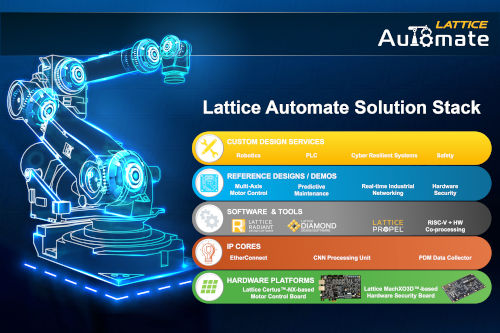
To help customers overcome these challenges, leading silicon vendors are offering more support for vertical and specialized applications to accelerate the development of new workloads, such as predictive maintenance proof-of-concept testing, trials with new coprocessing architectures, and prototype development with new specifications/integrations. Lattice’s Automate™ industrial automation range, shown in Figure 2, is an example of a complete solution already available. Real-world implementations of new processor technologies that meet common safety requirements, such as SIL-2 or safety coprocessing (e.g., reference designs, project examples, etc.), are powerful demonstrations of redundancy/security that can be better evaluated than theoretically through datasheets or simulations.
A range of automation tools typically comprises a diverse array of IP that is crucial for the application and valuation of the automation silicon vendor (ecosystem). Industrial automation and control systems already incorporate extensive functionality, such as graphical interfaces, real-time response, wired and wireless network connectivity, local event analysis, and robust formats. However, the sophistication of these systems is increasing to support new capabilities critical to automation solutions, such as machine vision, object detection, and enhanced safety, among others. Providing these functions/capabilities along with a broader or more advanced support plan is fundamental for automation silicon and for the future viability of a solution.
Automation Ecosystem:
Major silicon suppliers have significantly enhanced their internal capabilities to offer specialized design services to original equipment manufacturers (OEMs) and others. For example, Lattice Semiconductor has an in-house design group for all application segments, enabling it to customize and integrate its solutions for AI and machine learning, vision, security, and automation, as well as a product services group that provides manufacturing and production support. The company also has a network of partner companies that have been trained and certified on its tools to ensure the quality of service provided by third parties. An ecosystem of partners providing high-quality design services is key to supporting greater silicon technology support closer to the application level, with specialized support for the fragmented supplier segment and technologies for robotics, PLCs, protection, and systems.
Eric van der Heijden, Vice President of Sales EMEA, Lattice Semiconductor