

In recent years, as factories have begun to reduce labor costs and increase efficiency, the concept of predictive maintenance—detecting anomalies before equipment failures occur—has gained widespread acceptance. This has increased the need for machine health monitoring and the use of sensors to detect equipment conditions (e.g., motor vibration).
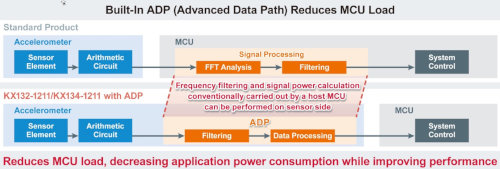 The KX134-1211 is a 3-axis accelerometer optimized for machine condition monitoring. Advanced Data Path (ADP) technology allows the accelerometer to perform noise filtering and sensor signal processing that is normally handled by the MCU. This helps reduce the MCU load and power consumption while achieving improved application performance. Furthermore, to meet industrial requirements, the frequency and acceleration sensing ranges have been increased to 8500 Hz and ±64 g, respectively, while supporting operating temperatures up to 105 °C. At the same time, the sensor itself consumes less than half the current (0.67 µA in low-power mode) compared to conventional products. Additional features include Wake Up and Back to Sleep functions, which further reduce power consumption, enabling sensing operation on battery-powered handheld devices.
As a leading supplier of compact accelerometers, Kionix responds to market needs by developing products for the industrial sector. Kionix will continue to contribute to the growth of the IoT society by expanding its range of high-precision, low-power sensors.
(fig 1)
Key Features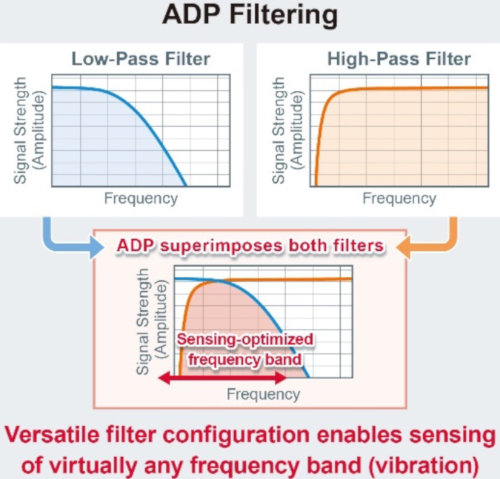
1. ADP (Advanced Data Pass) Technology Reduces MCU Load.
ADP is a new feature from Kionix that replaces the filtering function of conventional MCUs. Specifically, multiple customizable frequency filters integrated into the sensor eliminate unnecessary noise signals by employing a versatile configuration that extracts only the necessary signals. Each filter can be turned on and off, allowing for flexible operation. Frequency filtering and signal power calculation (root mean square calculation), conventionally performed by a host MCU, can now be done on the sensor side, reducing the MCU load and associated power consumption.
(Fig. 2)
 2. Ideal for monitoring the condition of industrial equipment.
The KX132-1211 features a maximum frequency band of 4200 Hz and an acceleration detection range of ±2 g to ±16 g, while the high-performance KX134-1211 extends the frequency band to 8500 Hz and the acceleration range to ±8 g to ±64 g. Furthermore, unlike conventional products that can only operate up to 85 °C, both models allow operation up to 105 °C. The higher operating temperature and wider frequency and acceleration detection range make them ideal for monitoring the condition of machines, such as motor vibration analysis in industrial equipment.
(Fig. 3)
3. Reduces the power consumption of devices and applications.
The KX134-1211 consumes 63% less current than other conventional products (0.67 µA in low-power mode). Furthermore, a high-resolution Wake Up function reports when acceleration exceeds a user-defined value. A Back to Sleep function prompts the MCU to switch back to a power-saving mode when no acceleration is detected for a certain period. Reducing the power consumption not only of the accelerometer but also of the MCU when the signal of interest is absent improves the energy efficiency of the entire application, contributing to longer battery life in wearable devices such as smart keys and automotive applications.
(Fig. 4)
Application examples:
• Machine health monitoring, predictive maintenance, and condition/vibration monitoring (machine condition monitoring) on industrial equipment equipped with motors
• Logistics tracking in combination with GPS
• Wearable devices
• Smart keys for the automotive industry