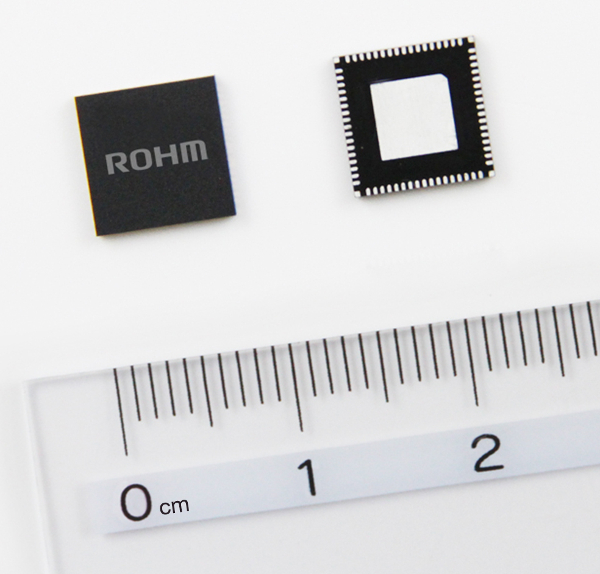
The BD2670MWV provides all the power supplies needed by Apollo Lake platforms and helps reduce power consumption. It comes in an ultra-compact UQFN68AV8080 package (8.0 x 8.0 mm, t = 1.0 mm) that reduces the number of components by 38% and the mounting area by 33% compared to conventional discrete configurations. It also incorporates Power Control Logic, which enables control and analysis of the PMIC's internal status, as well as access to the register via an I2C interface, thus increasing design security.
To date, ROHM has supplied a wide range of PMICs for diverse applications using market-leading analog design technology. Furthermore, ROHM has opened 11 design centers worldwide to provide customers with world-class support, and in the future, ROHM will continue to leverage its proprietary technologies and expertise to develop high-performance products and solutions that significantly contribute to energy savings and enhanced safety.
“We have established a joint development system to supply PMIC solutions designed for a variety of applications, from in-car infotainment systems to laptops and tablets. This new PMIC is based on a power supply configuration optimized for Intel’s next-generation processor architecture, targeting cloudbooks and 2-in-1 tablets. Its compact package is also expected to help achieve smaller and thinner form factors,” said Hisaki Ishida, General Manager of Reference Marketing Strategy at ROHM.
Key Features
1. All the power supplies needed by Intel's Apollo Lake architecture, integrated into an ultra-compact monolithic form factor.
In addition to market-leading analog design technology, ROHM leverages its expertise in supplying PMICs optimized for previous Intel® processors to develop an ultra-compact monolithic PIM that incorporates all the power supplies needed by Intel's new Apollo Lake architecture platform. This highly integrated design reduces the number of components by 38% compared to conventional discrete solutions, which in turn reduces the mounting footprint by 33%. It also incorporates a power supply sequencer optimized for the Apollo Lake platform, significantly reducing the design burden.
2. The built-in Power Control Logic function enables the analysis and control of the internal PMIC.
To prevent CPU malfunctions, a logic circuit is needed to detect anomalies and store information in the register when the PMIC's voltage output is irregular. ROHM's new ultra-compact (8mm x 8mm) PMIC includes the Power Control Logic circuit, which monitors and controls the PMIC's internal operation and can access the register via an I2C interface, thus ensuring a stable voltage supply.