In recent years, the increasing performance demands placed on automotive SoCs, driven by the evolution of ADAS, improved in-vehicle camera functionality, and the integration of ECUs, have accelerated the shift toward domain architectures centered on domain controllers. As a result, power supply designs now require the ability to support low-voltage, high-current operation, along with advanced power sequencing control and high reliability.
Conventional power supply architectures often require significant customization to accommodate differences between manufacturers and SoC generations, frequently resulting in redesigns during new model launches. This increases both development time and verification workload. To address these challenges, ROHM has developed this solution based on a configurable design concept that allows for flexible adaptation to a wide range of SoC power requirements.
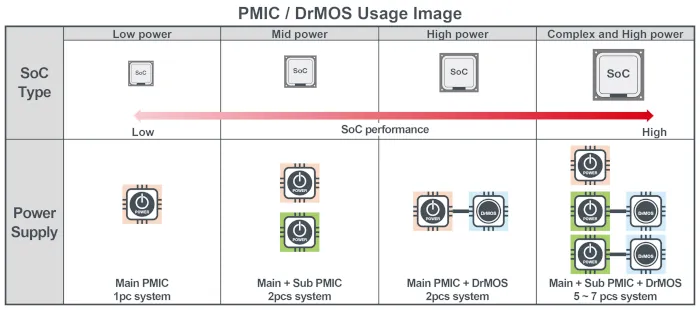
This solution enables scalable power supply designs compatible with a wide range of SoCs, from entry-level to high-end, by flexibly configuring combinations of configurable primary PMICs, secondary PMICs, and DrMOS devices based on application and performance requirements. This scalable approach reduces development effort during platform expansion while improving energy efficiency and design reuse.
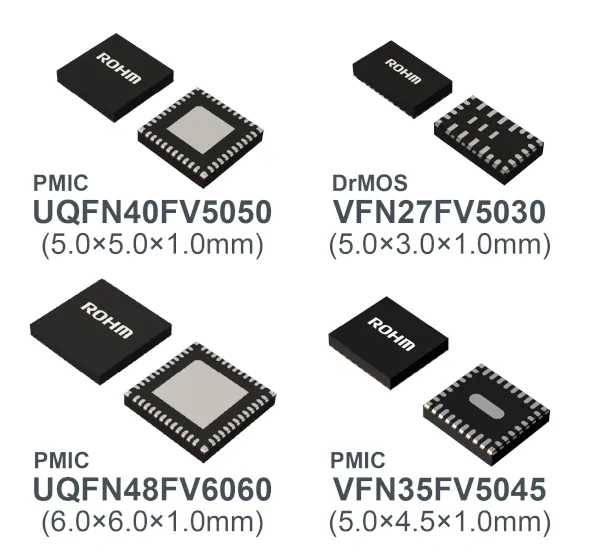
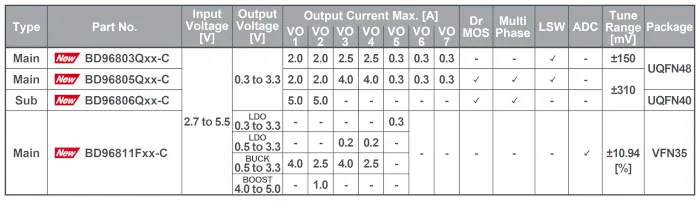
All PMICs are designed for an input voltage range of 2.7 V to 5.5 V. The BD96803Qxx-C and BD96811Fxx-C are optimized for standalone operation with low-end SoCs. The BD96805Qxx-C and BD96806Qxx-C , when combined with the DrMOS BD96340MFF-C, can meet the low-voltage, high-current demands of high-performance SoCs.
The PMICs are housed in QFN packages using Wettable Flank technology, while the DrMOS chips are in a QFN flip-chip package. All devices are AEC-Q100 certified, guaranteeing high reliability for in-vehicle applications. Series production of these products has already begun.
PMIC range
Examples of high-power SoC applications: ADAS, DMS, in-cabin integration systems, etc. Medium-power SoC applications: surround-view systems, parking assistance systems, etc. Low-power SoC applications: sensor cameras, body control systems, various sensor control systems, etc.