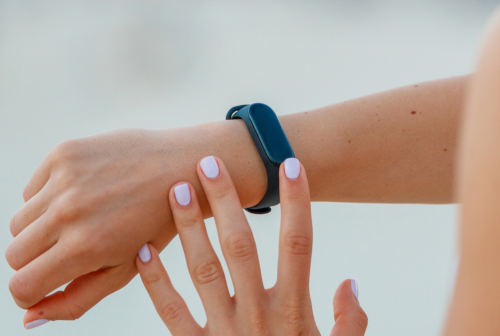
Comprising a complete integrated optical sensor module, a sensor hub IC, and a detection algorithm, the MAXREFDES220# optical blood pressure trend solution can be integrated into smartphones or wearable devices. It allows users to place their finger on a device for 30–45 seconds while at rest to measure their blood pressure anytime, anywhere. The reference design includes the high-sensitivity MAX30101 or MAX30102 optical sensor, as well as the MAX32664D sensor hub IC with embedded algorithms.
The MAX30101 (with three LEDs) and MAX30102 (with two LEDs) pulse oximeter and heart rate optical sensor modules combine photodetectors, LEDs, and analog front-end electronics (AFE) with an integrated glass cover. This integrated optical design and top-mounted lens focusing enables an optimal signal-to-noise ratio (SNR) for a small, lower-cost, and low-power module. It comes in a small 5.6 mm x 3.3 mm, 14-pin optical package with an I2C interface for the sensor hub IC.
The MAX32664D sensor concentrator IC includes firmware that controls the sensor and runs the algorithms that measure cuffless blood pressure, heart rate, and blood oxygen levels. Its ultra-small size (1.6 mm x 1.6 mm) allows it to easily fit into small devices for seamless and effortless connection to a device's host microcontroller.
The MAXREFDES220# provides industry-leading accuracy that meets Class II regulatory limits. For example, under resting-only measurement conditions, the solution provides the following accuracies:
Systolic Error: Mean = 1.7 mmHg, Standard Development = 7.4 mmHg;
Diastolic Error: Mean = 0.1 mmHg, Standard Development = 7.6 mmHg.
For reference, Class II regulatory limits are |Mean Error| ≤ 5 mmHg and Std Dev ≤ 8 mmHg.
This solution requires calibration every four weeks to maintain the above accuracies. This is based on independent testing and a limited number of resting subjects.
Key Advantages
: Best-in-class cuffless blood pressure measurement accuracy: The ready-to-use reference solution measures trend blood pressure without a cuff and meets Class II regulatory limits.
Ease of design: Highly integrated optical modules and ready-to-use algorithms in the sensor hub IC, along with comprehensive optical system design guidance, enable customers to integrate the finger-based blood pressure solution into their devices.
Faster time to market: The algorithm code runs on a dedicated, ultra-low-power sensor hub microcontroller, eliminating the need to integrate new code into an existing application processor.