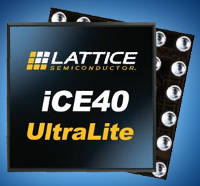
 The highly integrated iCE40 UltraLite devices provide a flexible logic architecture, programmable I/O, hardware IP, and LED drivers, all integrated into a very low-power FPGA and a sensor manager with instant-on capability. Designed to accelerate time to market with their powerful features, iCE40 UltraLite FPGAs consume 30 percent less power and occupy 68 percent less space than comparable FPGAs.
Lattice Semiconductor's iCE40 UltraLite FPGAs, now supplied by Mouser Electronics, are based on an advanced, ultra-low-power 40nm process. These FPGAs are available with logic cell densities of 640 or 1K cells and incorporate up to 56 Kbits of sysMEM™ Embedded Block RAM (EBR) for handling user logic, as well as two integrated oscillators: a low-frequency oscillator at 9.7 kHz and a high-frequency oscillator at 48 MHz. The former is ideal for always-on, low-power applications, while the latter can be used for wake-up functions.
The iCE40 UltraLite devices come with hardware RGB PWM and three user-configurable 24 mA constant current RGB control outputs. An integrated 400 mA IR LED output provides a direct connection to an external LED for IrDA functionality. The 100 mA barcode emulation driver output provides a direct connection for applications such as barcode reading, while the IR LED output and learning mode capabilities can be used for applications such as TV remote controls.
The iCE40 UltraLite FPGAs achieve flexible, reliable, and secure SRAM configuration via a standard SPI interface and internal non-volatile configuration memory (NVCM). Since the memory configuration can be stored in integrated non-volatile memory (programmable only once), no external configuration memory or circuitry is required.
The iCE40 UltraLite FPGAs from Lattice Semiconductor are now available through Mouser Electronics in a 16-ball WLCSP package with a 0.35 mm ball pitch and a 1.409 mm² footprint, or in a 36-ball BGA package with a 0.40 mm ball pitch and a 2.5 mm² footprint. The iCE40 UltraLite FPGAs are an ideal solution for a variety of small, low-power Internet of Things (IoT) and wireless applications, such as smartphones, tablets, medical devices, wearables, multi-sensor management, and RGB lighting controls.