The Crucial Role of Semiconductor Components in Space Missions:
Since the launch of the first U.S. satellite, Explorer 1, aboard the Jupiter-C missile, Microchip components have proven their suitability for space, meeting stringent radiation and reliability standards while in outer space.
The role of semiconductor components in space missions began with frequency control devices, which were crucial in early missions. Frequency control, such as quartz crystal oscillators, voltage-controlled SAW oscillators (VCSOs), or atomic clocks, is fundamental to space mission electronics, ensuring the accurate transmission and reception of signals, maintaining communication stability, data integrity, and system synchronization. These components were vital to the success of the first U.S. space mission in 1958 and laid the foundation for a legacy of reliability in space. The Apollo 11 moon landing in 1969, one of humankind's greatest achievements, also relied on these technologies. Microchip provided critical communications support within the Apollo 11 Lunar Module (LM) on the lunar surface.
Rubidium, SAW, and quartz oscillators support more military communications, satellite ground stations, and test and measurement applications than any other precision frequency reference in the world.
The Voyager 1 mission, currently the most distant human-made object from Earth, further demonstrated the unparalleled performance of semiconductors in space. Voyager 1's electronics included a combination of time-to-live (TTL) and complementary metal-oxide-semiconductor (CMOS) logic integrated circuits, analog components, memory chips, and custom semiconductors designed to meet the challenges of deep space. Voyager 1's main computer used a custom-built CPU (central processing unit) called the SPS-8, designed for the spacecraft by NASA. TTL logic chips were a popular type of digital integrated circuit at the time, whereas now most semiconductor integrated circuits are based on CMOS.
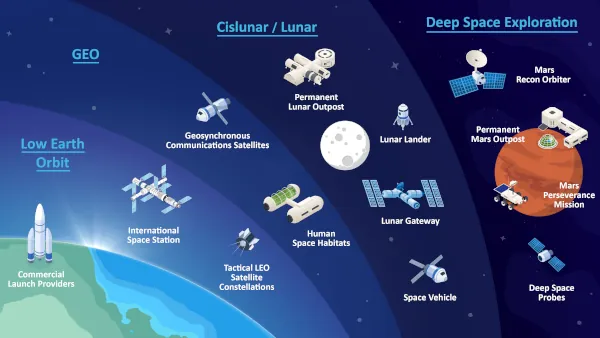
In recent years, semiconductor technologies have been fundamental to Mars exploration. The Curiosity and Perseverance rovers, which have provided invaluable information about the Red Planet, rely on these components to function in the harsh Martian environment. The Mars rover, specifically the Perseverance rover, contains several components from Microchip Technology. These include microcontrollers used for various control systems and data processing tasks, as well as power management integrated circuits that are crucial for efficiently managing power delivery to different parts of the rover. All of these are radiation-hard components, ensuring that the electronics can withstand the harsh space environment. These components are essential for the rover's operation and help it perform its scientific tasks on Mars.
Regarding lunar exploration, the Chandrayaan-3 mission, India's third lunar exploration mission, also utilized several semiconductor components. These components, such as radiation-resistant (RT) FPGAs, are crucial to mission success, enabling communication, navigation, and scientific experiments on the lunar surface.
The ongoing Artemis missions, which aim to return humans to the Moon and eventually send them to Mars, also rely on the proven performance and reliability of semiconductor technologies.
The Importance of Reliability and Performance in Space Programs
In the harsh environment of space, reliability and performance are not just important, they are critical. Semiconductor components are at the heart of modern space missions, powering everything from satellites and rovers to communication systems and space stations. Given the extreme conditions of space—extreme temperatures, intense radiation, and the vacuum of space—components must function flawlessly over long periods. Even the slightest failure in a semiconductor could lead to mission failure, highlighting the importance of selecting highly reliable components.
The Challenge of Radiation in Space:
Space is filled with high levels of radiation, which can be devastating to electronic components. This radiation can degrade materials, cause electrical failures, and corrupt transmitted data. For example, the solar radiation environment outside Earth's protective atmosphere can expose components to energetic particles that cause single-event upsets (SEUs) or total radiation dose damage.
To address these challenges, advanced radiation hardening techniques include the use of specialized materials, such as radiation-hardened semiconductors, and design modifications that reduce vulnerability to radiation. For example, space-grade microprocessors used in onboard computers are often radiation-hardened by design (RHBDs) so that a failure does not cause the entire system to crash.
Endurance Testing to Simulate Space Conditions:
In addition to radiation resistance, companies with a long history in space missions have pioneered rigorous testing and qualification processes that ensure the reliability and performance of their components. These tests go far beyond standard manufacturing quality control. Space-grade semiconductors undergo extensive thermal cycling tests, which simulate the wide temperature variations in space, from the intense heat of the Sun to the glacial cold of deep space. One example is NASA's testing of components for the Mars Perseverance rover, which experienced temperature swings from -55°C to 125°C, requiring components capable of withstanding such extremes without failure.
Components also undergo vibration testing to simulate the stresses and vibrations experienced during launch. The intense forces generated during rocket launches are unlike anything seen on Earth, so semiconductor components must be able to withstand these conditions without compromising their integrity. For example, during the Apollo 11 mission, critical electronic components underwent vibration testing to ensure they would survive the powerful forces of launch, ultimately contributing to the success of the moon landing.
Long-Term Reliability: Examples from Space History.
Space missions require components that not only function during the mission but also continue to function reliably over time. The Voyager 1 spacecraft, launched in 1977, is a prime example of how reliability is crucial for long-duration missions. After more than 40 years in space, the spacecraft is still communicating with Earth, thanks to semiconductor components that have been radiation-hardened and rigorously tested to withstand extreme conditions.
Another example is the International Space Station (ISS), which relies on numerous semiconductor-based systems to maintain life support systems, conduct scientific experiments, and keep communication lines open. The ISS is constantly exposed to the harsh radiation environment of space, with temperatures ranging from +121 °C (facing the Sun) to -157 °C (in the shade), yet the semiconductor components on board must function reliably day after day.
The Future of Semiconductor Components in Space:
As the space industry continues to evolve with the rise of low Earth orbit (LEO) constellations and the increasing commercialization of space, so too does the demand for reliable, high-performance semiconductor components. New space initiatives require components that can meet unique challenges, combining high reliability, innovation, and cost-effectiveness.
Expanding Frontier: The Evolving Space Market
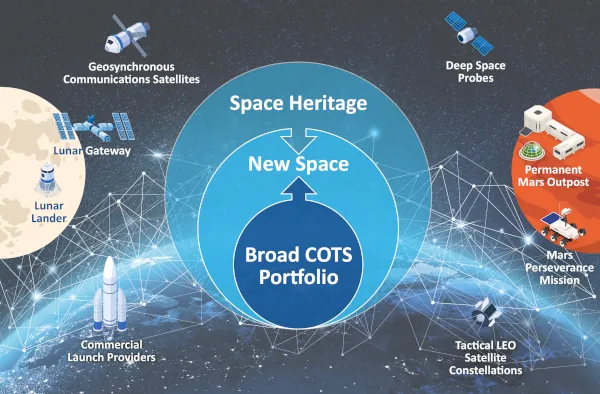
A growing trend in the space industry is the increased use of off-the-shelf (COTS) devices, which provide a cost-effective solution for space missions due to their immediate availability. The Starlink satellite network leverages COTS components to reduce costs and accelerate production. Many of the onboard electronics, especially for non-critical systems, rely on these components, which are inexpensive and have been carefully selected for their reliability in space environments.
A prime example is the European launcher developed jointly by the ESA (European Space Agency) and CNES (French Space Agency), Ariane. The Ariane 5 (1985) was equipped with a hardened QML-grade Sparc central processor in a hermetically sealed package and a 1553 network for communication between all the rocket's systems. The latest version, Ariane 6 (2024), now incorporates a COTS processor based on the Arm® architecture, with a plastic assembly and Ethernet for communication. This is also a widely adopted industry standard, in contrast to the space and military-specific technology used in Ariane 5.
However, for high-reliability systems that must maintain high performance in space communications, COTS devices must be adapted and certified, which requires specialized expertise. Companies wishing to enter the space market or transition from new space to deep space should collaborate with semiconductor companies with a proven flight track record, capable of upgrading COTS devices to meet the stringent demands of space missions.
Discover how the consolidated flight path paves the way for a new era of accessibility and collaboration in space applications
Microchip offers customers a simple path to move from COTS devices to space-qualified devices. This approach provides scalable and customizable solutions tailored to the unique requirements of each mission. This flexibility is essential in the space industry, a dynamic and constantly evolving sector where new technologies and mission profiles are continually emerging. By lowering the barriers to space commercialization and exploration, Microchip is facilitating broader access to space technologies and innovations.
In the near term, the future of semiconductors in space can be envisioned as a combination of several strategies: improving COTS devices, leveraging our spaceflight experience with sub-QML product versions to reduce selection requirements, lower costs, and shorten lead times, and customizing manufacturing processes to meet the unique requirements of specific mission profiles.
By combining these approaches, we will continue to ensure a robust and adaptable future for semiconductors in space.
In conclusion
, semiconductor components are crucial to the success of space missions, providing the necessary reliability and performance in the harsh environment of space.
As the space industry continues to evolve, the demand for reliable, high-performance semiconductor components will only increase.
Author: By Nicolas Ganry, senior marketing manager for Microchip Technology's aerospace and defense business unit