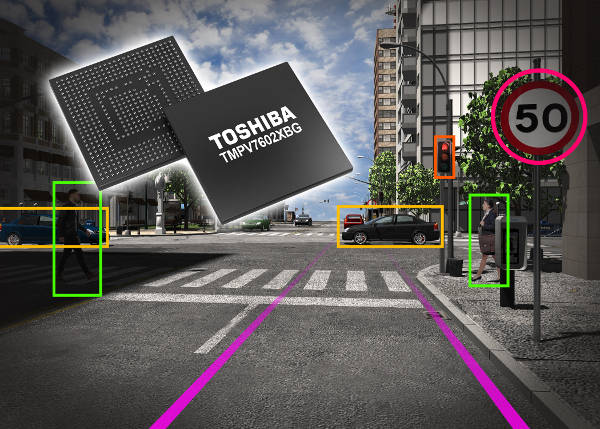
With 13 hardware-based image recognition accelerators, the TMPV7602XBG incorporates ADAS features that will be part of the Euro NCAP testing program for 2018. These include AEB (Autonomous Emergency Braking), TSR (Traffic Sign Recognition), LDW (Lane Departure Warning) / LKA (Lane Keeping Assist), HBA (Head Brake Assist), and FCW (Forward Collision Warning). Toshiba devices also support a range of new applications such as TLR (Traffic Light Recognition) and pedestrian detection at night.
ADAS applications are processed simultaneously within a typical 50 ms window inside the image recognition processor with relatively low power consumption due to the optimized hardware accelerators and media processing engines (MPEs). The TMPV7602XBG can process up to five applications concurrently while consuming less power than other mid-range and high-end ADAS-oriented devices. By using a single video input channel, a cost-optimized camera system with a small form factor can be achieved. The TMPV7602XBG integrates
new, improved CoHOG accelerators[1] that provide significantly higher image recognition accuracy than previous devices, especially in low-light and nighttime conditions. Color-based gradient analysis of images supplied by a connected Full HD (2-megapixel) camera also improves pedestrian nighttime detection rates.
Toshiba's new processor can handle multiple applications simultaneously in real time using its heterogeneous multi-core architecture. The device features newly integrated image processing accelerators and four Media Processing Engines (MPEs) supported by Floating Point Units (FPUs) that perform double-precision arithmetic calculations.
The chip is housed in a 17 mm x 17 mm BGA 521 ball package with a 0.65 mm ball pitch. Sample shipments of the TMPV7602XBG will begin in March 2016.