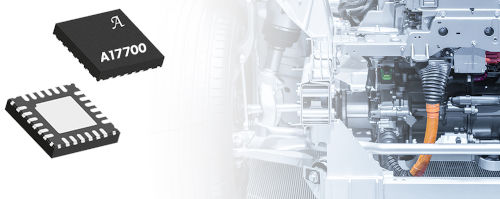
The A17700 is configurable for resistive bridge pressure sensors in a wide range of critical applications in today's efficient vehicles; from high-pressure systems such as dynamic braking systems (DBS) in turbocharged and hybrid electric (HEV) or gasoline direct injection (GDI) vehicles, to medium- and low-pressure systems such as brake boosters, HVAC applications for electrified vehicles, and oil management in automatic transmissions.
With its integrated polynomial algorithm, the A17700 interface sensor offers high accuracy for both pressure and temperature by processing a pressure signal in two stages. This flexible compensation provides high accuracy for resistive membranes that require high- or low-point characterization during assembly.
Achieving a balance desired by system designers, this device offers ways to improve system performance while maintaining flexibility. With robust EMC performance—up to 4kV HBM—the A17700 also enables up to 30% reduction in external components, resulting in a smaller overall solution footprint, a smaller printed circuit board, and a more cost-effective system design.
Featuring parallel processing paths for input and temperature, the A17700 achieves the lowest chip latency on the market. With an input-to-output processing delay of 100 µs, this ultra-fast interface sensing IC allows systems to compensate for the effects of vibration on the diaphragm without loss of output resolution, further enhancing system fidelity.
Environmental conditions, such as changes in supply voltage level, temperature, input jumper signal, and connection, can cause temporary failures in pressure sensing systems. The A17700 captures these changes and signals them in the output protocol, enabling system-level fault filtering for more accurate safety notifications.
The A17700 is available in a small 24-pin 4mm × 4mm QFN package with wettable flanks, ideal for ensuring reliable soldering and visual inspection of solder joints.