According to Nader Sadrzadeh, CEO of Kionix, “As the number of sensor applications increases, we look for uses that are broad enough to add embedded algorithms and functionality directly to our sensors. Pedometry has crossed this threshold: the usefulness of detecting when someone walks and then counting their steps goes beyond monitoring physical exercise, as it can be adapted to understand the mobility of recovering patients and the elderly, to help identify changes in location, improve logistics and employee efficiency in the workplace, among other examples.”.
The trend toward embedded functionality directly in a sensor offers advantages beyond providing a complete, easy-to-use pedometer solution; it also extends battery life. Sadrzadeh adds, “By optimizing the algorithm for low power consumption and incorporating it into our sensor, we add less than 100nA compared to an accelerometer without this feature. This is equivalent to a very small fraction of the power consumption of a pedometer algorithm on an external microcontroller.”
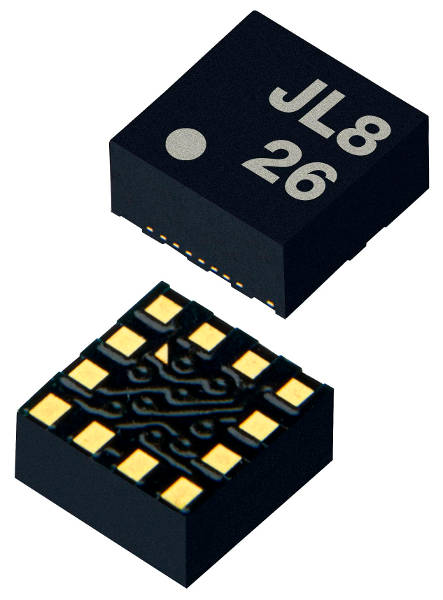
The KX126 is a high-resolution (16-bit) triaxial digital accelerometer supplied in a very compact 2mm x 2mm x 0.9mm LGA package. It offers support for normal/fast/high-speed I2C communication up to 3.4MHz and SPI communication up to 10MHz, with adjustable ranges of +/- 2g, 4g, and 8g, precise temperature synchronization, and configurable low-noise and low-power modes.
In addition to its pedometer function, it incorporates a 2048-byte FIFO buffer that can capture seconds or minutes of movement data while the rest of the system remains at rest. Other key features include its high sampling rates (up to 25.6 kHz) that enable the detection and capture of fast, high-frequency movements, and a high-resolution activation/motion detection algorithm capable of detecting movements as small as 3.9 mg. Furthermore, the embedded and highly customizable digital motors allow for automatic detection of tilt, freefall, screen orientation changes, as well as single and double taps.