Therefore, it is ideal for battery protection systems in cordless vacuum cleaners, power tools, and other portable equipment.
The ML5233 also boasts an industry-leading low current consumption of 0.1 μA during power cut-off, minimizing the effects on battery capacity - even during long-term storage - and contributing to greener products, with virtually no energy loss from the charged battery.
Furthermore, the integrated short-circuit current and temperature detection circuits enable the detection not only of overcharging/discharging and overcurrent, but also of abnormal (high) temperatures during discharge, along with battery pack short circuits—all without an MCU. This reduces the footprint by 20% and decreases the number of external components from four to one, resulting in smaller battery protection systems and a lighter development overhead.
The demand for cordless battery-powered vacuums and power tools that use secondary lithium-ion batteries is increasing worldwide every year due to their greater convenience and ease of use. Weight reduction for improved portability and other design factors are also considered important.
Lithium-ion secondary batteries offer greater energy efficiency per volume and weight compared to nickel-metal hydride and nickel-cadmium hybrid batteries, enabling size and weight reductions. However, a drawback is that they require continuous monitoring and control to prevent fires, explosions, and/or reduced battery life, increasing the demand for compact, low-power LSIs for battery monitoring.
 Looking ahead, LAPIS Semiconductor will continue to meet the needs of consumer and industrial equipment markets for higher voltage battery monitoring systems, offering low-power multi-cell lithium-ion battery monitoring LSI.
Key Features ① Industry-leading low current consumption.
In operation, current consumption is reduced to 25 µA, 50% less than conventional products, contributing to greater energy savings for the entire system.
During power outages,
current consumption during power outages is also the lowest in the industry (typically 0.1 μA.), which has little or no effect on battery capacity even during prolonged storage and ensures minimal energy loss from the charged battery.
 ② Higher detection accuracy increases charging efficiency by 7%
High overload detection accuracy (± 15 mV per cell) increases charging efficiency by 7% compared to conventional products with an accuracy of ± 50 mV.
③ Multiple fault detection and protection functions implemented without a microcomputer reduce size by 20%.
Integrated short-circuit current and temperature detection circuits enable the detection of abnormal (high) temperatures and short circuits in the battery pack without an MCU, decreasing the mounting area by 20% and reducing the number of external components from four to one. Furthermore, the hardware-based configuration using an external MOSFET, current-sensing shunt resistor, and thermistor contributes to smaller protection systems and reduced development overhead.
④ The scalable, multi-stage series connection supports systems with more than 10 cells.
High-voltage processes support 4–10 cells in series using a single LSI, ensuring compatibility with power tools and other equipment in the 14–36 V range.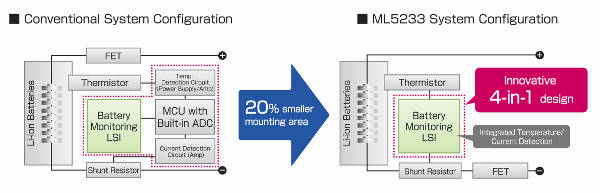
 Furthermore, the versatile design allows scalability to support a wide range of applications. For example, two LSIs can be combined to support up to 20 cells in series and up to 72 V, making them suitable for pedal-assist bicycles, wheelbarrows, and other high-voltage applications.
Applications:
Cordless vacuum cleaners, power tools, and similar items.
Availability
ML5233 is available (samples), serial production will begin in September 2015.