The new EBVchips presented include:
Mercury integrates a fully programmable, low-power Cortex M0+ microcontroller with a fully functional embedded wireless M-Bus stack. It also incorporates an ultra-miniature balun paired with the SPIRIT1 transceiver, supporting connection to an external antenna. The integrated microcontroller offers ample resources for customized applications and provides all necessary interfaces. The module is pre-certified and compliant with CE and R&TTE regulations.
It is designed for smart grid applications: energy meters, temperature meters, water flow meters, gas flow meters, heat meters, high-end online meters, and more.
Mercury is a low-power, low-cost, and compact 433 MHz wireless M-Bus module.
Janus, with embedded Internet Protocol, enables scalable wireless sensor networks for IoT applications.
Janus is a low-cost, embedded 868 MHz RF module specifically designed for home automation, smart lighting, and general IoT applications. It utilizes a full 6LoWPAN protocol stack, offering IETF IPv6 compatibility, star and mesh topologies, self-configuration (by proximity detection), unicast, multicast links, and self-healing capabilities.
The module's small form factor (15 mm x 14 mm) is ideal for surface-mount (SMD) mounting.
Its low power consumption is achieved with a low-power ST Microelectronics STM32F0 microcontroller and the SPIRIT1 low-power sub-GHz transceiver. It also integrates an ultra-miniature balun that pairs with the SPIRIT1 and supports an external antenna connection, saving space and cost. As users can integrate their region-specific application layer, there is no need for an external host controller. The module is pre-certified and compliant with CE and R&TTE regulations.
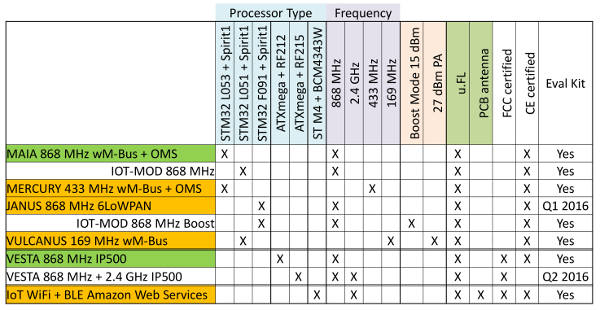 Vulcanus is a compact 169 MHz wireless M-Bus module for surface mounting with an RF front-end and a microcontroller with embedded wireless M-Bus protocol software that supports the new EN 13757 - 4:2013 Mode N standard and is pre-certified for operation under European radio regulations.
The Vulcanus module measures 15 x 34 x 3.8 mm and contains a communication engine with built-in Wireless M-Bus protocol software, a high-performance RF transceiver, and an amplifier. The communication engine manages the radio packet protocol, the UART interface, and controls the RF transceiver, as well as the external inputs and outputs. The external host processor handles module configuration by sending "AT" commands to the communication engine via UART, allowing configuration of the frequency, channels, output power, GPIO behavior, and other parameters. These commands are used to initiate and terminate communication, as well as to put the module into sleep mode for ultra-low power consumption when not in use. Some configuration parameters are stored in internal non-volatile memory to be restored by a power-up sequence. The module features advanced filtering circuitry to suppress harmonics and spurs.
Vulcanus is focused on long-range connectivity applications: connectivity for smart street lighting, IoT infrastructure for smart cities, connectivity for sensors in wearables, and long-range perimeter monitoring.
It was developed to be wM-Bus compatible for the CIG (Comitato Italiano Gas) according to the UNI/TS 11291-11-6 specification.
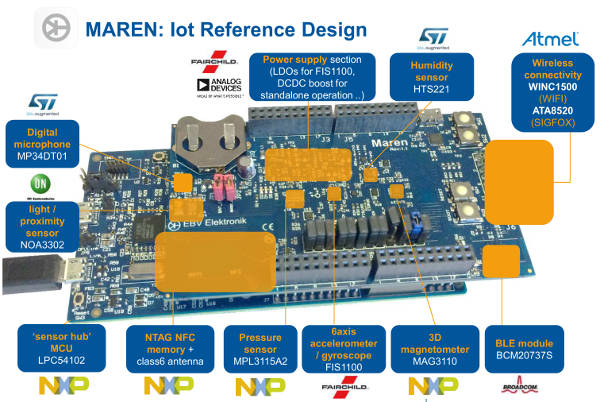
Furthermore, EBV Solutions presents MAREN, a new reference design platform for IoT, focused on applications such as MEMS sensors (motion, environment), connectivity (BLE and NFC), and sensor processing algorithms. Application offerings:
It utilizes an NXP LPC54102 microcontroller, a FAIRCHILD FIS1100 6DOF inertial measurement unit, and many other features. MAREN is a high-performance, flexible, connected sensor hub. It features
F3™ sensor fusion algorithm.
The FIS1100 is the world's first consumer IMU to provide pitch, roll, and yaw specifications. It comes standard with Fairchild XKF3™ high-performance 9-axis sensor fusion algorithms and includes an integrated AttitudeEngine™ motion processor for longer battery life, easier adoption, and an enhanced user experience.
The high-performance XKF3 9-axis sensor fusion algorithms combine data from the on-chip gyroscopes and accelerometers with data from an external magnetometer. Sensor fusion also includes automatic background calibration, enabling excellent performance in terms of accuracy, consistency, and smoothness. When combined with the XKF3 sensor fusion algorithms, the FIS1100 is the first consumer inertial measurement unit with orientation (quaternion) specifications that deliver pitch and roll accuracy of ±3° and yaw accuracy of ±5°.
NXP LPC54100: Ultra-low power microcontrollers for always-on sensor processing
The LPC54100 series microcontrollers were designed from the ground up to offer improved energy efficiency for always-on sensor processing applications. These high-efficiency microcontrollers support ultra-low power performance for sensor tasks such as listening, collecting, and aggregating sensor data, as well as complex sensor processing tasks such as sensor fusion.
Crucial for always-on complementary applications, the LPC54100 series microcontrollers require only 3 µA for continuous sensor listening.
For the first time in sensor applications, an asymmetric dual-core architecture enables scalable active performance/power:
Developers can use the 55 µA/MHz Cortex-M0+ core for sensor data collection, aggregation, and external communication, or the Cortex-M4F (100 µA/MHz) core to run math-intensive algorithms (i.e., motion sensor fusion) faster while saving on power consumption.
The LPC54100 series also includes single-core (Cortex-M4F) options with similar sensor listening and M4F power efficiencies.