In recent years, these automotive systems have become increasingly electrified, and the motors used must achieve greater efficiency, lower noise levels, and a more compact size. Furthermore, as the number of installed electronic control units (ECUs) increases, reducing the number of components and minimizing board space has become increasingly important. Together, these trends are driving a growing demand for highly integrated devices that combine a microcontroller (MCU) and a gate controller for motor control.
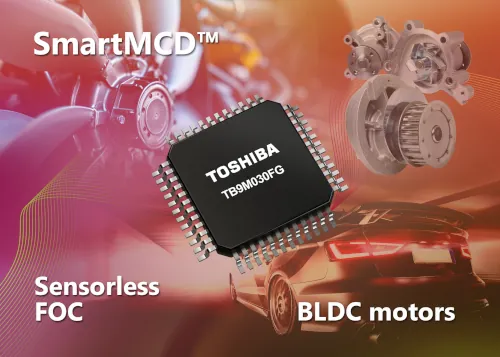
Sensorless control of three-phase BLDC motors presents challenges in accurately detecting rotor position at low speeds, creating a strong demand for high-performance sensorless FOC technology capable of providing stable control from the stall point. The TB9M030FG integrates a 32-bit MCU with an Arm® Cortex®-M0 core, 64 kB of flash memory, an additional 12 kB of ROM, and 4 kB of RAM. The gate driver controls and drives the N-channel power MOSFETs for the operation of the three-phase BLDC motor. The product also features a local interconnect (LIN) network transceiver and a power supply system that can operate at automotive battery voltage levels.
This highly integrated component is housed in a small QFP48 package, with typical dimensions of 9 mm × 9 mm, enabling engineers to design more compact systems and reduce the number of components. The product also incorporates Toshiba's Vector Engine coprocessor, which supports short FOC cycle times, reducing CPU workload and software program size in motor control applications. Furthermore, Toshiba's innovative sensorless control technology enables FOC position control from zero speed to the low-speed range when used with optimized PM synchronous motors—that is, three-phase BLDC motors with magnetic anisotropy in the rotor (Ld ≠ Lq), allowing for reluctance torque generation due to magnetic reluctance differences within the motor.
Compared to the conventional high-frequency injection method, where a voltage (or current) signal is superimposed and injected into the motor to detect rotor position, this approach eliminates the noise caused by harmonic injection and also results in quieter motor operation. This enables more advanced and sophisticated motor control, making the product suitable for a wide range of automotive motor applications.