Applications include automotive battery management systems (BMS), on-board chargers (OBCs), inverters and other high-voltage subsystems, as well as energy storage systems (ESSs) and industrial power control equipment. As automotive and industrial systems continue to transition from mechanical to solid-state relays, designers require reliable, highly isolated gate control solutions that eliminate the need for secondary-side power supplies. The new TLX9920 generates the gate control voltage directly from its photovoltaic output, enabling simplified circuit design while maintaining enhanced isolation between the control and power domains.
The TLX9920 is optimized for controlling high-voltage power MOSFETs in SSR applications. When combined with external MOSFETs, it enables high-voltage and high-current switching that is difficult to achieve with conventional photorelays. Unlike mechanical relays, SSRs have no physical contacts, eliminating contact wear, reducing maintenance requirements, and improving long-term reliability. The device complies with the AEC-Q101 automotive reliability standard.
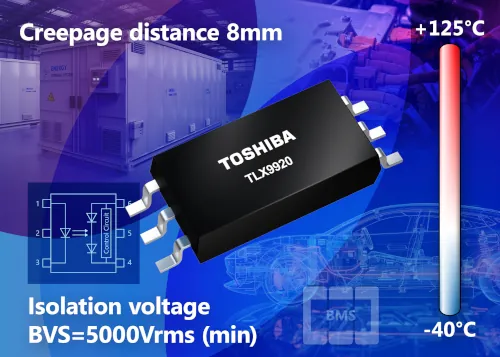
Housed in a slim SO6L package (3.84 mm × 10.0 mm × 2.1 mm), the TLX9920 features a minimum creepage distance of 8 mm and a high rated insulation voltage of 5000 Vrms (min.). This makes it suitable for applications requiring reinforced insulation. For example, IEC 60664-1 specifies that an 8 mm creepage distance may be required for systems operating at 400 V or higher in pollution degree 2 environments, requirements that the TLX9920 meets.
With a minimum open-circuit voltage (VOC) of 13.5 V and a minimum short-circuit current (ISC) of 8 μA at a forward current (IF) of 10 mA, the TLX9920 provides ample gate control capability for MOSFET control without requiring an additional isolated bias source. Its integrated discharge circuitry further simplifies design and ensures reliable turn-off performance.