




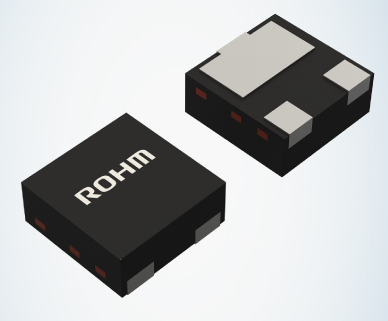
The increasing electrification of vehicles in recent years has significantly increased the number of electronic and semiconductor components used in each vehicle.  Consequently, the need for a dramatic increase in component density has become even more critical. For example, the average number of multilayer ceramic capacitors and semiconductor components installed in a single automotive ECU (electronic control unit) is expected to increase by 30%, from 186 pieces in 2019 to 230 pieces in 2025. At the same time, for high-density automotive applications requiring further miniaturization, research is currently underway on encapsulated back electrode packages that can achieve excellent heat dissipation in a compact form factor.
For automotive parts, Automated Optical Inspection (AOI) is performed after assembly to ensure reliability. However, with back electrode components, the weld joint cannot be verified because the terminals are not visible, making it difficult to perform a visual inspection that meets automotive standards. ROHM has solved these problems with its original Wettable Flank technology, which ensures an unprecedented side electrode height of 125 µm in the 1.0 mm × 1.0 mm size and has been very well received by several vehicle manufacturers.
Extremely high weld assembly reliability is achieved during AOI in automotive systems requiring high quality. Furthermore, the new back electrode encapsulation simultaneously provides revolutionary miniaturization and high heat dissipation, making it ideal for ADAS and automotive ECUs (electronic control units) with higher board densities.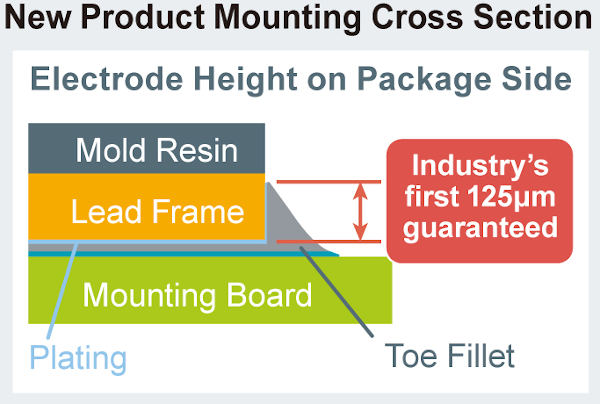
In addition to MOSFETs, ROHM is committed to further expanding its range of diode and bipolar transistor products.
Key Features 1. Original Wettable Flank Technology Ensures a Side Electrode Height of 125 µm
With conventional bottom electrode encapsulations, the sides of the conductor frame cannot be metallized, making it difficult to perform AOI to verify the weld height required for automotive applications. In contrast, ROHM's new MOSFETs utilize patented Wettable Flank Technology to ensure a revolutionary side electrode height of 125 µm in a 1.0 mm × 1.0 mm size. This enables stable weld fillet formation even with bottom electrode encapsulations, allowing for AOI verification of the weld condition after assembly.
 2. Ultra-compact, high-heat-dissipation MOSFETs support high-density mounting.
ROHM’s new MOSFETs achieve the same performance as 2.9 mm × 2.4 mm packages (SOT-23 packages) but in a smaller 1.0 × 1.0 mm package (DFN1010 packages), thus reducing the mounting area by approximately 85%. Furthermore, the adoption of a high-heat-dissipation back electrode structure improves heat dissipation (which typically decreases with size) by up to 65% compared to SOT-23. As a result, the RV8C010UN, RV8L002SN, and BSS84X are ideal for automotive ECUs and ADAS that are experiencing higher board densities due to increased performance.
Application examples
: Suitable for switching and reverse connection protection applications
- Control ECUs for autonomous driving
- In-car infotainment
- Engine control ECUs
- Drive recorders
- ADAS applications
Availability: In mass production
Terminology Automotive Reliability Standard AEC-Q101
AEC stands for Automotive Electronics Council, an organization responsible for establishing reliability standards for automotive electronics. The Q101 standard is specifically intended for discrete semiconductor products.
Wettable Flank Forming Technology
: This is a technique for metallizing the sides of the conductor frame in bottom electrode encapsulations such as QFN and DFN. This technique significantly improves weldability.
AOI (Automated Optical Inspection)
The boards are scanned with a camera and automatically inspected for missing components, quality defects, and soldering conditions.








