 The growing demand for smart home devices and IoT applications has added communication functionality (i.e., Wi-Fi) to household appliances. Since these devices need to be constantly powered on to maintain communication, manufacturers are being required to further reduce standby power consumption to approximately 0.5 W. This necessitates lower standby power consumption from the motor and power supply units, as well as new and innovative technologies.
Many devices require a zero-crossing detection circuit to detect the 0 V point (zero-crossing point) of the AC waveform in order to provide efficient control of both motors and MCUs. However, in terms of power consumption, conventional zero-crossing detection circuits use a photocoupler that accounts for almost half of the total system standby power consumption.
(Fig. 2+3)

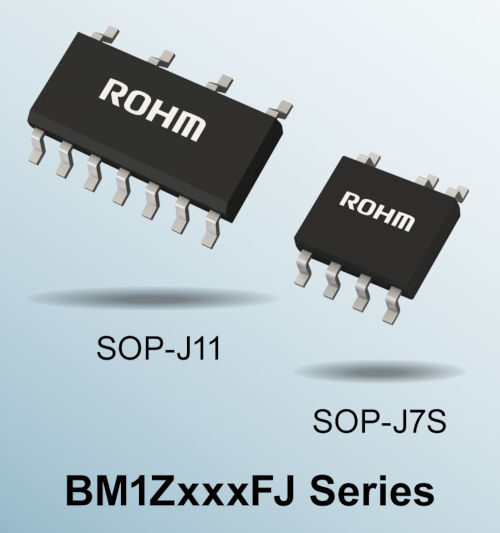
To address this issue, ROHM has developed the first integrated circuit with a zero-crossing detection solution for power supplies in the home appliance sector. This integrated zero-crossing detection circuit provides designers with a turnkey zero-crossing detector without the need for a complex design using discrete components. Furthermore, this integrated solution does not use a photocoupler, which is typically found in other solutions, thus further reducing standby current consumption and increasing long-term reliability.
The BM1ZxxxFJ series reduces the standby power consumption of the zero-crossing circuit to just 0.01 W while continuously supplying power to the system. Furthermore, the time-delay error (which varies depending on the AC voltage) present in conventional photocoupler-equipped zero-crossing detection circuits is limited to ±50 µs or less. This enables efficient operation of motors—even with the different AC supply voltages used in various countries and regions—as well as MCUs. At the same time, eliminating the need for a photocoupler contributes to greater application reliability by reducing the risks associated with degradation over time.
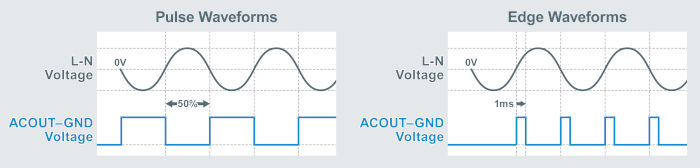
Both the impulse and edge waveforms used in appliance specifications are compatible with the BM1ZxxxFJ series, eliminating the need for software changes when replacing conventional zero-crossing detection circuits.  ROHM offers six models to ensure compatibility with a wide range of appliances.
(Table 1)
It is compatible with two output waveforms depending on the specifications
(fig. 4)
 Evaluation Board:
A zero-crossing detection integrated circuit development board is available that integrates a power supply to drive the ROHM zero-crossing detection integrated circuit and facilitates device evaluation. This evaluation board is designed to simplify the decision-making process for designers considering replacing existing circuits that use a photocoupler.
Availability: Now available.
Support page: https://www.rohm.com/products/power-management/ac-voltage-zero-cross-detection-ics
(A user manual for the evaluation board is also available.)
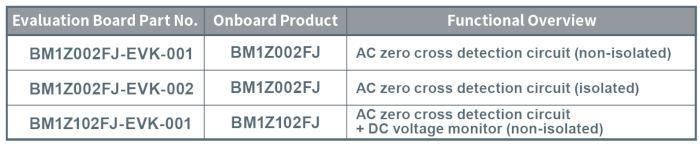
Assessment plate range
(table 2 + fig. 5)