


They function as a communication bridge between the end device and the telephone network, managing the dialogue with the base stations. This management enables fast, reliable, and low-latency data transmission. Thanks to its extensive coverage and high connection speeds, 4G technology makes them ideal for handling large volumes of data in real time, even for devices located in remote areas or in constant motion.
The fundamental value of these modules lies in their ability to provide continuous and secure mobile connectivity without requiring human intervention, allowing devices to efficiently send and receive data. In the Internet of Things (IoT) and other applications, their main advantage is facilitating communication in challenging locations and scaling solutions without relying on local network infrastructure. Furthermore, LTE modules typically include the capability for over-the-air (OTA) firmware updates, simplifying maintenance and improving long-term security.
For these reasons, LTE modules have become a key component for strategic sectors such as telemetry, fleet management, remote healthcare, smart agriculture, and connected cities. However, choosing the right module is crucial, as it makes the difference between a limited prototype and a robust, scalable product. Technical factors such as power consumption, size, physical connections, and protocol and security support are determining factors. A good module should also offer integration tools (commands, drivers, examples) that accelerate the time to market for the final solution, ensuring both reliability and optimized operating costs.
The Neoway N706, represented by Mecter SL, is an ultra-compact 4G Cat.1bis wireless communication module, measuring just 17.7 mm x 15.8 mm x 2.3 mm, designed for M2M and IoT applications with industrial requirements. It is the most cost-effective 4G module on the market and also stands out for its low power consumption. Its 109-pin LGA design and small dimensions make it ideal for smart meters, automated point-of-sale systems, surveillance cameras, beacons or trackers, embedded gateways, and more.
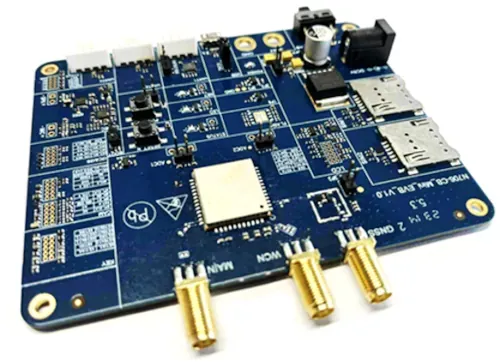
Main features:
• LTE Cat.1 connectivity: maximum speed of up to 10 Mbps download and 5 Mbps upload.
• Platform and performance: ARM Cortex-A5 at 500 MHz with 32 KB I-cache and 32 KB D-cache caches, 8 MB RAM and ROM available in 4 MB or 8 MB.
• Dimensions and packaging: 15.8 mm × 17.7 mm × 2.45 mm, 109-pin LGA.
• Operating range: powered between 3.4 and 4.2 V (typically 3.8 V); standard working temperature −30 °C to +75 °C (extended −40 °C to +85 °C).
• Consumption: < 3 mA in Sleep mode, < 15 mA in Standby and up to 650 mA in operation.
• Frequency bands: FDD-LTE: B1/B3/B5/B8; TDD-LTE: B34/B39/B40/B41.
Integrated interfaces and functionalities
It supports GNSS (optional) for positioning, Wi-Fi scanning, PCM, and a wide range of interfaces: three UARTs (one with flow control), USB 2.0 HS, three SPI ports, two I2C ports (one recommended for codecs), I2S for audio, two 10-bit ADCs, USIM (1.8V/3.0V), and multiple interrupt-enabled GPIOs. It also supports common IoT protocols and services: MQTT, TCP/UDP, FTP, HTTP/HTTPS, and SSL/TLS encryption.
Reliability and support for production
The N706 is presented as an industrial-grade solution with design reference availability, evaluation kits, and technical support (including local updates via UART/USB and OTA), facilitating certification and integration into commercial products.