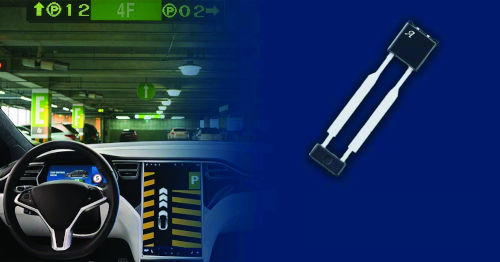
According to a recent report by the consultancy Strategy, the first passenger vehicles with Level 3 capabilities (conditional automation) should be widely available by the end of 2022, and Level 4 capabilities (high automation) should be available in people-carrying applications by 2025. By 2030, vehicles incorporating Levels 3, 4, and 5 (full automation) are expected to represent 20% of the total market in Europe, 12% in the United States, and 11% in China. Although progress has been slowed by COVID-19 and regulatory hurdles, automakers are actively developing software and hardware systems and need components—such as the A19360—that can enable those systems.
“Our new A19360 sensor is a game-changer for automakers working on autonomous vehicles,” says Peter Wells, director of the Speed Interfaces and Sensors business line at Allegro. "It is designed for automation levels 3, 4, and 5 of the SAE J3016 standard, and helps to safely enable features such as parking assist, fully autonomous parking, and traffic jam assistance with positional measurement 4 times better at the location where the tires touch the road. It can even improve autopilot functionality and low-speed control in dense environments."
Automated and autonomous vehicles require superior wheel rotation information for precise low-speed control. The A19360 provides high-resolution information to automotive systems by generating additional output events per magnetic cycle using a special protocol compatible with electronic control units (ECUs). It includes an 8-event-per-magnetic-cycle mode for ADAS applications, providing one increment for every approximately 5 mm of tire roll. It also includes a 4-event-per-magnetic-cycle mode that doubles the number of outputs per magnetic cycle (compared to a standard wheel speed sensor). This allows designers to halve the number of poles on the ring magnets in the wheel to save costs, or increase the air gap while still achieving the same number of increments per revolution.
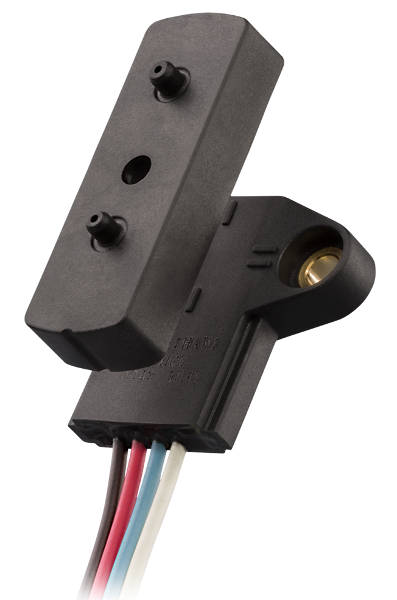
The A19360 was developed to ISO 26262 ASIL B(D) and is based on Allegro's monolithic GMR technology, featuring ultra-low jitter and high air gap capacity. The company's SolidSpeed Digital Architecture™ provides the widest operating air gap dynamic range and highly adaptive performance that eliminates flatlining due to thermal drift and system dynamics.
Pricing and Availability:
The A19360 is available in a lead-free (Pb) 2-pin SIP package (suffix UB) with a tin-lead frame coating. The UB package includes an integrated IC and protection capacitor in a single overmolded package, with an additional molded lead stabilizer bar for easier transport and assembly.