The IN 200 offers significant performance improvements, particularly in linearity, offset, and noise immunity, compared to traditional fluxgate magnetic induction transducers, thanks to its innovative digital technology.
It achieves unparalleled accuracy in linearity and electrical offset. While the IN 200's datasheet specifies 0.6 parts per million and a maximum of 10 ppm, internal testing has demonstrated that the sensor can achieve linearity below 0.5 ppm and an offset of +/-5 ppm. Competitor transducers offer +/-20-25 ppm.
With this new transducer designed for automotive test benches, manufacturers can not only improve the efficiency of inverter testing and validate performance levels by accessing more accurate data. On the other hand, because inverters will reduce power losses, designers will have the potential to address the “range concern” by enabling EVs to travel farther than is currently possible.
The IN 200 completes LEM’s IN family of high-precision sensors, which now covers a current range of 100A to 2000A. The IN 200 itself consists of three products capable of achieving nominal currents of 100A, 200A, and 400A.
The factor that most differentiates the IN 200 from its competitors is LEM’s shift from analog circuitry to digital integration technology. To achieve the ever-increasing levels of accuracy demanded by the test and measurement market, LEM is reinventing magnetic induction technology. Traditionally, many analog circuits were needed to cancel noise and other effects from the various magnetic induction coils, but LEM's innovative solution substantially reduces the number of analog circuits integrated into the transducer by using digital integration to transform the signal. Operating in the digital domain, the new sensor offers a wider range of capabilities, including ripple compensation, second harmonic detection, and voltage regulator excitation.
LEM believes the IN 200 outperforms its closest competitor in virtually every aspect. While the market has shown it can make do with the lower performance levels offered by other power measurement transducers, the IN 200 gives manufacturers the potential to achieve previously unattainable levels of accuracy and efficiency.
"The trend is very clear," says Horst Bezold, founder of Signaltec. “The increasing electrification of transportation is putting enormous pressure on inverter test benches in the automotive sector and has generated a boom in demand for test and measurement equipment. LEM has responded to this with a market-leading solution that will help alleviate this pressure. By eliminating the traditional reliance on analog technology, we have achieved levels of accuracy that no one else in the market has been able to match. This is excellent news for the test and measurement industry.”
The IN 200 offers many other advantages to users, including significantly reduced noise and exceptional immunity to external fields. The device’s digital technology ensures immunity to the effects of temperature, interference, and supply voltage variations, while its high-quality metal housing (previous models used plastic) improves EMC immunity, reduces temperature drift, and enables high-precision operation over an extended temperature range (-40°C to +85°C).
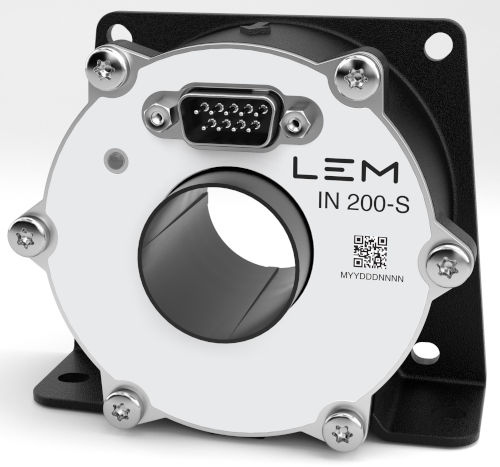
Other features of the IN 200 are its very wide frequency bandwidth from DC to 1.1 MHz (-3 dB), its compact design with a 28mm opening for cables and bus bars, and a status signal to indicate the transducer's status.





- Details
- Category: Sensors
LEM IN 200 current measuring transducer for test and measurement applications
LEM is offering record levels of accuracy in current detection with the launch of its IN 200 current measurement transducer. The IN 200, the most accurate sensor of its kind on the market, is ideal for demanding applications such as high-precision test and measurement equipment used to analyze the efficiency of inverters for hybrid electric vehicles (HEVs) and electric vehicles (EVs).



Print Magazine

Annual subscription price:
You will receive all 10 editions that are published each year.
social networks
Popular News Electronics
Spanish electronics magazine. Printed for over 25 years.
Spain - Madrid - All rights reserved © Convertronic Professional Spanish Electronics Magazine.