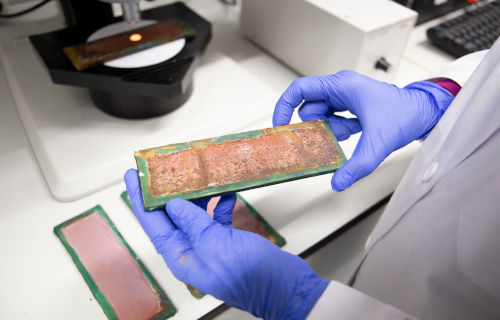
Within the framework of the project, the different coating and sensor solutions have been validated under real conditions at the Marine Corrosion Test Site “El Bocal”, an open sea Marine Laboratory located on the coast of Cantabria near Santander, and in the port of Mutriku (Gipuzkoa).
Electrode sensor for monitoring.
Work has been done on developing a sensor capable of accurately measuring the actual condition of the coating in situ, in a system where maintenance involves extremely high effort and cost.
“We have manufactured a sensor consisting of two interdigitated electrode combs that can be integrated into the coating itself, within the wind turbine's paint scheme, thanks to its small size and low cost, providing a reliable source of first-hand information on the condition of the protective layer of these offshore structures,” says Raquel Bayón, director of the Tribology Unit at Tekniker.
In the case of monitoring sensors, the AVANSURF initiative has confirmed the effectiveness of the technique for use in monitoring and predicting the degradation of organic coatings in offshore applications, in order to carry out, minimize, optimize and schedule maintenance operations.
“This technology still needs further development in terms of sensor design and results interpretation, in order to accurately correlate them with the degradation state of different coating systems,” Bayón concludes.
AVANSURF is a project completed in 2021, which had a budget of 5 million euros and was framed within the CIEN program of the Centre for Industrial Technological Development (CDTI) of the Ministry of Science and Innovation of the Government of Spain.