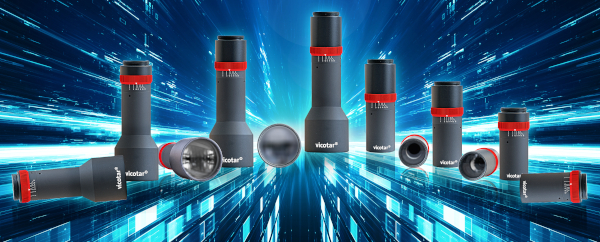
Image sharpness and depth of focus are two optical parameters that, unfortunately, counteract each other. The more a lens reduces the aperture, the more blurred the image becomes due to diffraction. However, industrial image processing requires both: maximum sharpness and the greatest possible depth of focus. The newly developed "Blue Vision" lens series meets these requirements. To achieve this, the Thuringian-based optics specialists take advantage of the fact that diffraction intensity depends on wavelength. If a specific lens with an aperture of f/10 creates an airy disk with a radius of 8 µm under red light (650 nm), then the disk is only 5.5 µm in size under blue light (450 nm), reducing blurriness by almost a third. It is therefore logical to perform precise image analysis under blue light whenever possible: blue LEDs (Deep Blue) in particular have an extremely high level of effectiveness.
It would be misleading to assume that lenses that haven't been color-corrected could be used for monochrome analysis. Blue LEDs have a full-width half-maximum (FWHM) of 20 nm to 30 nm. This can lead to transverse chromatic aberrations that change the reproduction scale, as well as axial chromatic aberrations that misalign the focus. For example, an uncolor-corrected lens with a reproduction scale of 0.2 and a lens field diameter of 15 mm creates a 10 µm fringing effect at the edge of the image if the wavelength varies by 20 nm. Therefore, the image appears blurry, and the additional axial chromatic aberrations further blur the center of the image.
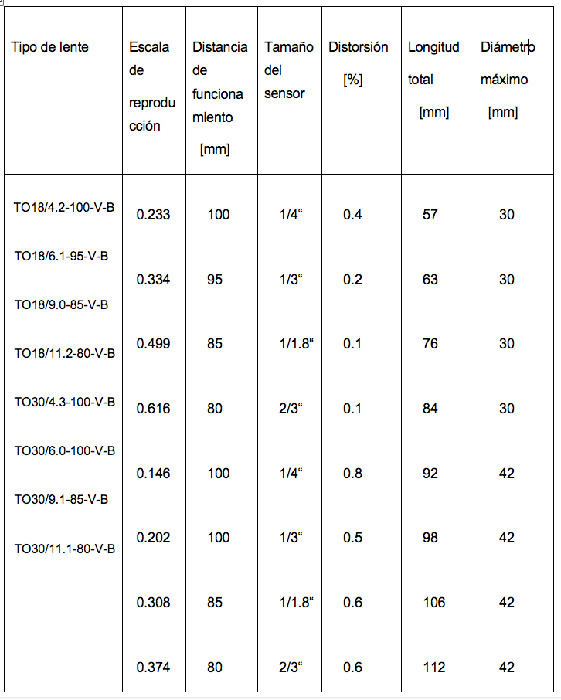 For lenses that cover the entire visible light spectrum, color correction is complex and particularly prone to errors in the blue light region (450–480 nm). Therefore, the color correction for Blue Vision lenses is specifically set in the blue spectral range at 470 nm. As a result, only extremely small axial chromatic aberrations of less than 10 µm, below the detection threshold, occur between wavelengths of 450 and 490 nm. The distortion of this lens is less than 1%.
Currently, the range consists of four telecentric lenses, each with a field of view diameter of 18 mm and 30 mm. The reproduction scales of the individual models were chosen to cover all prevalent sensor sizes. In each case, this produces image field diagonals of 4.1 mm (1/4"), 6.1 mm (1/3"), 9 mm (1/1.8"), and 11 mm (2/3").
Suhl's developers placed particular emphasis on a compact design. As a result, the T18/0.23 is only slightly longer than a conventional endocentric lens. While the lenses retain Vision & Control's streamlined design, the tube wall thickness has been engineered to withstand harsh industrial use.
All lenses have an adjustable aperture. From f/8 to f/11 (depending on the model), they are diffraction-limited and, as a result, are also suitable for 5-megapixel sensors. For use in extreme conditions, Blue Vision models are also available in shockproof versions with a fixed aperture and bonded lenses.
The T18 series has a 28mm lens tube diameter (30.5mm aperture ring) and can be locked to this size. The T30 series lenses are 42mm thick only at the front, but otherwise have the same diameter as the T18 series to accommodate them on the same mounts. Suitable lens mounts are available.
Because the Blue Vision series has been specifically optimized for blue light, its lenses are only suitable for red light or even infrared light up to a certain point. That's why the developers at Vision & Control are already working on a series of lenses for this spectral range.