Due to existing technological limitations, temperature control on a typical induction hob relies on the temperature of the back of the ceramic glass plate used in induction hobs. With the MLX90617, Melexis has developed an advanced yet cost-effective solution capable of "seeing through the glass" to provide real-time temperature readings at the base of a cookware.
The principle
: Using precise optical filtering techniques specifically tuned to the ceramic glass used in induction hobs, the MLX90617 is able to detect the radiation emitted from the bottom of the cookware that is transmitted through the ceramic glass plate. Energy from the ceramic glass plate itself is taken into account using an advanced algorithm.
Operation:
The MLX90617 is designed to be used in conjunction with another non-contact temperature sensor (such as the MLX90614 or MLX90632), which is also mounted beneath the ceramic surface of the cooktop. Optionally, an on-site emissivity measurement using an LED and a light sensor can be considered for best-in-class accuracy.
To determine the cooking vessel temperature, the MLX90617 measures the radiation emitted by the base of the pot or pan, while the second sensor measures the radiation emitted by the ceramic hob and the sensor. The accompanying LED and light sensor are used to measure the reflectivity of the vessel and thus calculate its emissivity. Through relatively simple real-time processing, it is then possible to determine only the temperature of the base of the cooking vessel, ignoring the radiation from the ceramic surface and the sensors.
Compared to a standard induction hob that measures the temperature of the ceramic glass (Tglass), the MLX90617, using advanced optical filtering, observes through the glass to provide a real-time reading of the cooking vessel's base (Tpot measured). When comparing the results, it is clear that the measurement provided by the MLX90617 is significantly closer to the actual temperature of the pots and pans (measured vessel).
Since the temperature of the pot or pan's base is monitored by the sensor, rather than the glass, the hob's control electronics have a more accurate view of the food's temperature. This is particularly advantageous for cooking operations that require precise temperature control within narrow temperature ranges. It can also contribute to increased system safety by detecting out-of-range temperatures, as well as enabling the development of more advanced automated cooking systems.
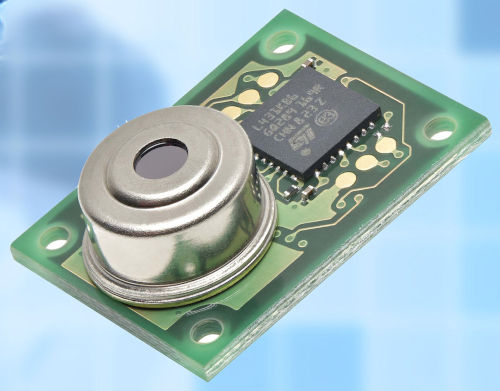
The MLX90617 features a wide, factory-calibrated operating temperature range of -0°C to 125°C and is designed to measure cookware temperatures between 70°C and 250°C. It is available in the industry-standard TO39 package with a 5V supply voltage. The SMBus digital interface is easy to integrate into induction cooktop designs.
The TO39 package houses both the infrared-sensitive thermopile detector chip and the signal conditioning ASSP, along with a built-in low-noise amplifier, a 17-bit ADC, and a powerful DSP unit.
Learn more