The AQ2300 series modular SMU, designed to address diverse density requirements for semiconductor/communication devices, offers high-quality pulse generation along with high-precision voltage/current generation and measurement. Thanks to its inherent productivity and expandability, the 2-channel SMU module also saves time and space by performing the typically complex and essential measurement functions for semiconductor devices.
SMU's AQ2300 series allows users to select the number of channels required (up to 18) to meet system needs in a limited space, supporting efficient facility operation.
The generation of high-quality pulse waveforms (50 μs width) is also an important feature. This function suppresses the heat generated by the device during testing, enabling more accurate measurements. Rise and fall times may be affected by the device or wiring, but a smooth output waveform can be achieved by adjusting the parameters.
Another key feature is interoperability. The AQ2300 series SMUs have trigger ports not only on the main frame but also on each SMU channel. Furthermore, the synchronization functionality within the frame allows for flexible selection of the connection method. In total, three trigger synchronization functions are available:
• Synchronization of frames with external equipment
• Synchronization of SMU channels with external equipment
• Synchronization between SMU channels
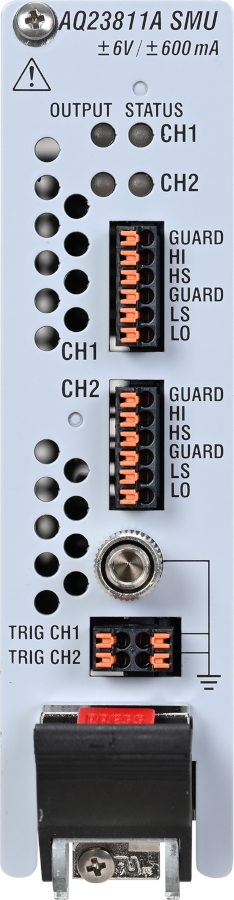 The frame can also feature a digital input/output (I/O) interface, enabling integration with external devices. Frames are available in 3-slot or 9-slot configurations, allowing for flexible adaptation to small and medium-sized measurement systems. Importantly, the AQ2300 SMU series offers flexible control over measurement timing, contributing to improved overall system performance.
In terms of productivity, the AQ2300 series enables simultaneous voltage and current measurements. Furthermore, by accelerating communication within the frame and with a PC, the new SMU fosters high levels of work efficiency, as high-speed data transfer reduces overall measurement time and improves operational efficiency.
Applications
• Static testing of laser diode modules: The AQ2300 series SMU can generate different voltages or currents from multiple channels and use the sweep synchronization function to measure the I/V or I/L characteristics of optical communication devices such as laser diodes. It can also perform wavelength-I measurements on photodiodes in synchronization with an adjustable light source.
• Filter characteristic testing of WDM (wavelength division multiplexing) photodiode modules: The AQ2300 series SMU can generate different voltages or currents from multiple WDM channels and use the sweep synchronization function to measure the filter characteristics of each individual channel.
Additional Technical Information: One
of the main advantages of the AQ2300 Series high-performance, high-speed SMU is its optimized response settings. Users can easily configure the AQ2300 Series units to reduce rising-edge waveform overshoot and ripple/ringing. Configuration simply requires entering the load's R (resistance), L (inductance), and C (capacitance) values. These values do not need to be re-entered when changing ranges.
The response tuning function, combined with digital feedback technology, also supports the generation of high-quality pulse signals (50 μs minimum pulse width, 100 μs minimum cycle time).
Regarding source and measure functions, each channel in each slot of the AQ2300 series SMUs offers the option of voltage or current, generation or measurement, or both. The SMU begins generating and measuring upon a trigger input, such as an internal timer or an external input signal. This functionality allows users to capture measurements without the unstable timing that occurs immediately after an output change.
Other features of the rack and the SMU include the ability to store up to 100,000 measurement data points per channel, reducing the number of measurement divisions. Additional notable features include channel-to-channel and module-to-module isolation, as well as hot-swappable modules.
To further explain the SMU's digital I/O option for interoperability with other equipment, the digital I/O interface allows users to receive an event start signal from external equipment and send an event end signal to the same external equipment. For example, when a 5V signal (or rising edge) is input to the digital I/O from external equipment, the SMU begins generating and measuring. Once the source or measurement is complete, the SMU sends a 0V signal (or falling edge) to the external equipment via the digital I/O.
The digital I/O interface helps avoid the polling operations that would otherwise be necessary to monitor the start and stop timing of the SMU's voltage or current source/generation.